One of the more controversial transportation issues in Congress has been the federal vehicle “kill switch” mandate created under the 2021 Infrastructure Investment and Jobs Act. Critics argue the provision could eventually require technologies capable of monitoring drivers and preventing a vehicle from operating if software determines a driver may be impaired.
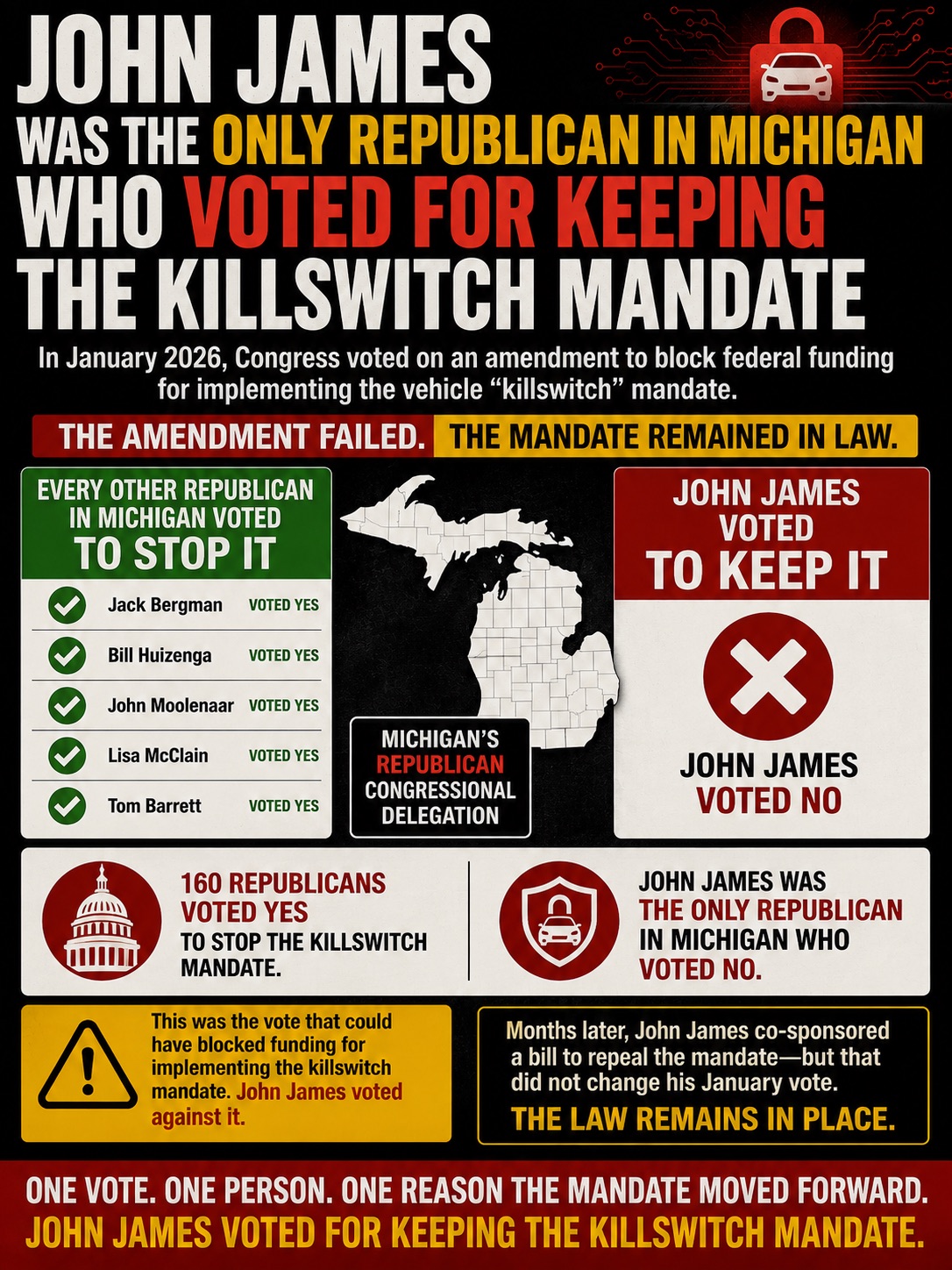
In January 2026, Congressman Thomas Massie offered an amendment to block federal funding for implementation of the mandate. The amendment failed by a vote of 164-268. According to published roll calls, 160 Republicans voted in favor of stopping the mandate, while 57 Republicans joined Democrats in voting against the effort. Among those Republicans was Michigan Congressman John James. (Newsweek)
What makes James’ vote particularly noteworthy in Michigan is that he was reportedly the only Republican member of Michigan’s congressional delegation to vote against the amendment designed to halt implementation of the mandate. While Republicans across the country overwhelmingly supported Massie’s effort, James sided with the coalition that defeated it. (Newsweek)
The vote became politically problematic because many conservatives had been raising concerns about the technology for years. Critics argued that government-mandated driver-monitoring systems create privacy concerns, could malfunction during emergencies, and place too much authority in automated systems. Others worried that future administrations could expand the technology beyond its original intent. (CBT News)
After the January vote, opposition to the mandate continued to grow. As criticism mounted, legislation known as the “No Kill Switches in Cars Act” gained attention in Congress. Then, in April 2026, John James announced that he had become a co-sponsor of legislation to repeal the very mandate he had effectively helped preserve just months earlier by voting against Massie’s amendment. James described the mandate as “Orwellian and intrusive” and said he did not support vehicle kill switches. (Congressman John James)
The timeline has created an obvious political vulnerability. Opponents argue that if James truly opposed the mandate, the most important opportunity to stop it came during the January vote when Congress considered whether to cut off funding for implementation. Instead, he voted against the amendment. Only later, after criticism intensified and after the mandate remained in place, did he join legislation seeking repeal. (Newsweek)
Supporters of James may argue that his later co-sponsorship demonstrates a willingness to revisit the issue and support repeal. Critics counter that the later legislation came only after the political damage had already been done and after the January vote had placed him on the record against the principal effort to stop implementation. (Congressman John James)
The facts are straightforward. In January 2026, John James voted against an amendment that would have blocked funding for implementation of the vehicle kill switch mandate. Months later, he became a co-sponsor of legislation to repeal that same mandate. Whether voters view that as a change of heart or an attempt to correct a politically damaging vote is likely to become part of the debate surrounding his record.