
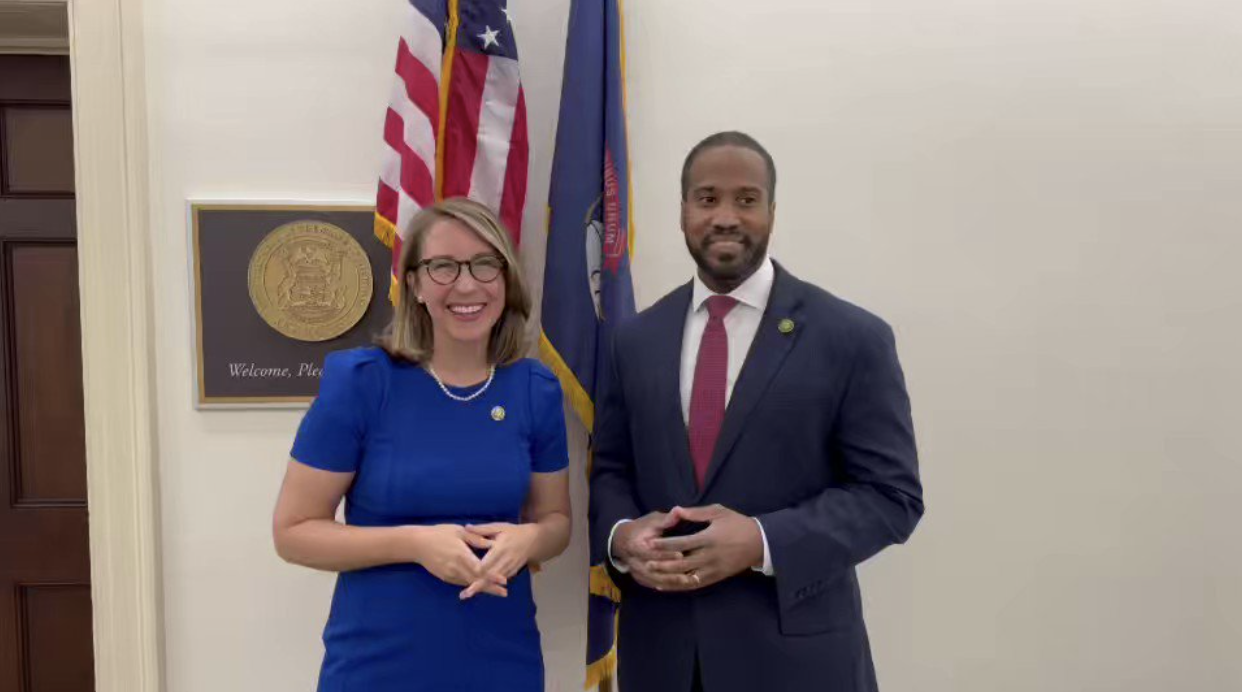
In today’s political environment, where partisan lines are often sharply drawn, moments of bipartisan cooperation tend to draw attention—especially when they involve rising Republican figures aligning closely with progressive Democrats.
That’s exactly what happened when Congressman John James teamed up with Democrat Hillary Scholten to introduce federal legislation aimed at subsidizing childcare costs through a “Tri-Share” model.
At first glance, the proposal appears straightforward. But a closer look raises an important question for voters: why are they working so closely together on expanding a federally backed program?
A Government-Backed Cost-Sharing Plan
The legislation mirrors Michigan’s Tri-Share model, dividing childcare costs into three parts:
- One-third paid by the federal government
- One-third paid by participating employers
- One-third paid by families
The proposal includes roughly $250 million annually over three years to fund the pilot program, targeting families earning up to 500% of the federal poverty level.
Supporters argue the plan addresses a real and growing challenge. Childcare costs have surged nationwide, putting pressure on working families and employers alike. Business groups in West Michigan have been vocal about the issue, framing childcare as a workforce participation problem.
From Michigan Pilot to Federal Expansion
The federal legislation is modeled after a Michigan-based initiative that has been praised in some circles for helping employers recruit and retain workers.
Backers say the approach strikes a balance between public and private responsibility. But critics point out that scaling a state pilot into a federally funded program represents a significant expansion of government involvement—and a long-term financial commitment for taxpayers.
A Bipartisan Alignment That Deserves Scrutiny
Bipartisan cooperation is often described as a virtue in Washington. But not all alliances are created equal—and not all policy directions are neutral.
When a Republican lawmaker partners this closely with a progressive Democrat on a proposal that relies on new federal spending, it’s fair for voters to take a step back and ask:
- What is driving this partnership?
- Is this a one-off issue, or part of a broader governing philosophy?
- Does this approach align with conservative principles of limited government and market-driven solutions?
These are not abstract questions. They go directly to how elected officials approach policy—and who ultimately bears the cost.
The Bigger Debate: Government vs. Market Solutions
There is no question that childcare affordability is a serious issue. But conservatives have long argued that the solution should focus on:
- Reducing regulatory burdens that drive up costs
- Expanding supply through market incentives
- Empowering families with greater flexibility—not federal dependency
The Tri-Share proposal, by contrast, leans on federal funding as a core component. Even with employer participation, the program introduces a new layer of government involvement in a sector traditionally shaped by private decision-making.
Flashback Worth Remembering
This partnership between John James and Hillary Scholten offers more than just a policy case study—it provides insight into governing instincts and priorities.
For Republican voters, particularly in a competitive statewide environment, it’s worth remembering moments like this. Not necessarily as a final judgment—but as a data point.
Because in politics, alliances matter.
And when those alliances form around expanding federal programs, voters have every right to ask a simple question:
Why?