The Briefing, Vol. XIV, Issue 5
Feb. 2, 2026
This week:
- Trump deescalates again — and it might work again
- Support for deportations continues, despite what you hear
- Democrats’ 2030s problem is still a problem
Outlook
Minnesota ICE: President Trump is best-known for doubling down. But sometimes, a good climbdown is just the thing. It helped him deal with the Greenland controversy last month in a constructive manner, ending with a deal that gives the U.S. what it essentially needs. Now it’s helping him keep a foot on the gas with respect to immigration laws without all the catastrophic political consequences.
After two shootings related to protesters harassing immigration officers, Trump took Border Patrol Commander Greg Bovino off the job and sent Tom Homan as his peacemaker. Homan, who is known for tough talk, instead took a conciliatory tone and appears to have worked out a deal that will give ICE access to more of the state’s prisons and jails, so that illegal immigrant criminals and defendants can be appreheneded without incident.
Although conservatives are already demanding justice over what might be a criminal conspiracy to obstruct immigration enforcement — and Homan hinted that that might still be happening — this will probably result in more deportations of more dangerous characters, all without the vigilante leftist militia street patrols and shootings.
Shutdown looming: A more conciliatory approach is also needed for another key reason: Congress is currently expected to avoid a government shutdown by approving appropriations bills for most of the government this week (if not tonight), while merely extending Homeland Security funding by two weeks. ICE will continue to operate under a multi-year appropriation, whether the government shuts down or not. But to fund the rest of the department (including TSA and FEMA, for example), Democrats will demand changes. They have to come away with something to get to 60 votes when the time comes, or else they will suffer with their base.
Republicans are already maneuvering to find a way to help them save face. Potential reforms will include universal body cameras for immigration enforcement (which, ironically, are usually helpful to law enforcement) and changes to ICE vetting and training.
Popular issue, unpopular agencies: This is important politically because it helps support Trump’s signature issue of immigration, the very first one he talked about when declaring his candidacy in 2015. Immigration enforcement agencies’ tactics (mostly ICE but also Border Patrol) are becoming less and less popular, with 61 percent saying they have “gone too far” in a New York Times-Siena poll last month.
Even so, a majority of 50 percent agree with the mass deportations being conducted. What they don’t like is the street chaos, most of which isn’t necessary for the policy anyway, if the experience of Texas, Florida, and other states cooperating (to some degree or another) with ICE is any indication.
Also of note: President Trump is sticking with Homeland Security Secretary Kristi Noem, whose hasty comments immediately after both the ICE shooting of Renee Good and the Border Patrol shooting of Alex Pretti have been widely panned. This is not only a very Trump thing to do, but also a very PR thing to do. Trump’s decision to take immigration enforcement out of her portfolio makes her eventual resignation, perhaps months from now, almost inevitable.
Reapportionment update: A new item circulating online this week is the reapportionment forecast from the American Redistricting Project. We have been watching these carefully going on three years, since their 2024 estimates based on 2023 data portended a massive future problem for Democrats. The 2024 estimates for the projected 2030 map would have handed Trump an extra net 12 electoral votes over Kamala Harris, based on the outcome of the 2024 election.
The 2025 estimates last year looked slightly better for Democrats, with a net gain for Trump of just ten electoral votes over Harris.
The projections are in now based on just-released July 2025 figures. According to the American Redistricting Project, the map looks just ever so slightly better for Democrats in terms of 2024 results — Trump would gain only an extra nine electoral votes if that election were held again with the same voting results. However, note that this is not a clean or easy improvement. Pennsylvania and Wisconsin, two states Democrats typically count on to win the presidency (even though Trump won both), each lose a seat by this year’s reckoning:
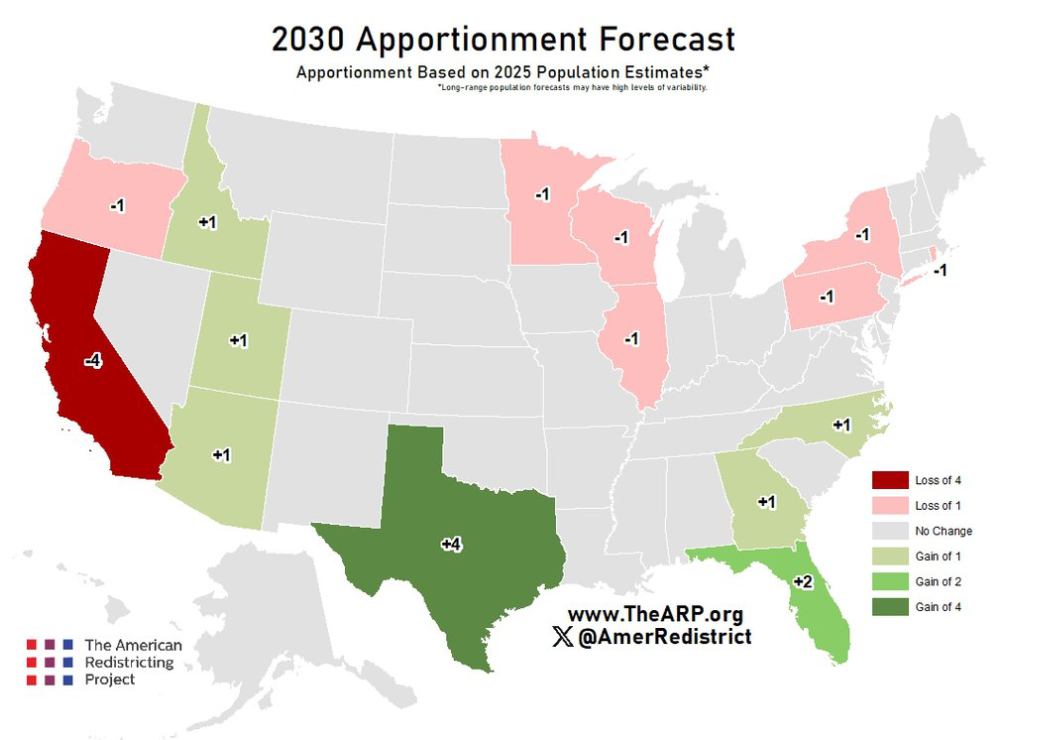
These projections are never precise as to which states will slightly improve or collapse in net migration. The leftist Brennan Center, for example, looked at the same numbers and projected that New York would lose and Florida gain one additional seat, for a slightly different result. Other seats that could be on the bubble to gain are South Carolina and Tennessee, while others on the edge of losing more seats include Michigan, New York, and Illinois.
But the overall trend remains largely the same. States governed by iron-clad Democratic uniparties are especially losing population — California, Illinois and New York all lost population in absolute terms between 2020 and 2025, which is unusual. Typically, the states that lose seats are merely failing to keep up the rest of the states’ pace of growth. Actual population loss is uncommon.
The states that lose seats in apportionment will lose both House seats and electoral votes before the 2032 election. All else being equal, this will make it harder for Democrats to win the presidency in the 2030s.
Governor 2026
Minnesota: As expected, Sen. Amy Klobuchar (D-Minn.) is running for governor. She has high name recognition and historic popularity — as a former DA, she even has a way of separating herself from her party’s radical anti-law-enforcement wing. But given the volatility of the situation in Minnesota, Republicans would be making a mistake if they were to roll over and just let her run the table against a nobody or some unelectable candidate. As more information becomes public about the multi-billion dollar fraud being exposed there, Klobuchar can, at the very least, be forced to take positions that impugn fellow Democrats.
Wisconsin: President Trump simplified this race by endorsing Rep. Tom Tiffany (R), who represents the northern reaches of his state. Immediately, Washington County Executive Josh Schoeman (R) dropped out. This gives Tiffany a chance to clear the field early on and focus on running a strong statewide race. The other formidable challenger eyeing this race now is former Gov. Tommy Thompson (R), who made a failed bid at a political comeback 14 years ago by running for U.S. Senate.
Democrats’ most prominent candidate in this race is former Lt. Gov. Mandela Barnes (D), who lost in the 2022 election cycle in a challenge against incumbent Sen. Ron Johnson (R).
Senate 2026
Kansas: Rep. Sharice Davids (D) is pulling a launching what people used to call a “listening tour” statewide, possibly in preparation for a statewide run. Local media speculation is that Davids, who represents the Kansas City and Lawrence area and had a brief scare about her district potentially being drawn out from under her, is considering a bid against Sen. Roger Marshall (R).
Maine: Gov. Janet Mills (D) is getting crushed in fundraising by her Nazi-tattoo-wearing primary opponent Graham Platner (D). The oyster-farming self-described “Antifa super-soldier” reported $3.7 million cash on hand at the end of the quarter, compared to Mills’s $1.3 million. The winner of this race will face Sen. Susan Collins (D).
Florida: Former Trump impeachment witness Alex Vindman (D) jumped into the Democratic Senate primary last week to challenge Sen. Ashley Moody (R), and already Democrats are getting out of his way to clear the field. Former Brevard County School Board Member Jennifer Jenkins dropped out and endorsed him. There are other declared candidates, but no one rising above the seriousness of former Rep. Alan Grayson (D).
Vindman, as a Trump antagonist, will likely raise a lot of money and get a lot more attention than Graysor or any of the other anonymous candidates. But Florida is still not the state it used to be where Democrats could easily take down a serious Republican incumbent who has appeared on statewide ballots previously. Not only did the Sunshine State re-elect by more than 13 points the man Vindman tried to remove from office, but it has also widened its voter registration gap to almost 1.5 million as of this month, up from 1.2 million at the time of the 2024 election.
Moody, the state’s former attorney general, was appointed to this seat to replace Marco Rubio when he became secretary of State. She has Trump’s endorsement and faces no serious primary challenge.
Michigan: State Sen. Mallory McMorrow (D), known for a viral speech arguing against parental rights in education, narrowly leads establishment favorite Rep. Haley Stevens (D) in the Democratic primary, 22 to 17 percent, according to a new Emerson poll. Former Wayne County Health Director Abdul El-Sayed (D) comes in a close third at 16 percent.
This is definitely a development Republicans can get behind, but the poll also shows all three narrowly leading or tied (in El-Sayed’s case) with likely 2026 nominee and former House Intelligence Chairman Mike Rogers (R). It will be a competitive race for sure, but Republicans have not won a Senate race in Michigan since 1994, and they have not won a statewide race since 2014, when they won all four statewide line offices.
New Hamshire: President Trump on Sunday changed the game a bit when he endorsed former Sen. John Sununu (R) against former Massachusetts Sen. Scott Brown (R). The two are running for Sununu’s old seat, which he lost to the now-retiring Sen. Jeanne Shaheen (D) in 2008. Democrats are almost certain to nominate Rep. Chris Pappas (D).
Ohio: As happy as Democrats were to land former Sen. Sherrod Brown (D) as their likely nominee, incumbent Sen. Jon Husted (R) is doing what he has to do to undermine Brown’s signature appeal to working-class voters. Last week, he collected another key union endorsement, his fourth of the campaign so far, the Washington Examiner reported. As in other red states where Democrats are finding it harder to win anything, many unions in Ohio are feeling pressure to cater more to both sides of the political aisle. Most union bosses and their unions are still officially backing Brown, of course, but every little bit helps for a Republican.
In 2024, 54 percent of voters in union households backed President Trump, with only 45 percent backing Kamala Harris. But in that same election, Brown, then the Senate incumbent, won 55 percent of union household voters, even as he was losing to now-Sen. Bernie Moreno (R-Ohio).
Husted, the state’s former lieutenant governor, was appointed to the Senate seat to replace JD Vance when he became vice president.