
The Briefing, Vol. XIII, Issue 23
June 9, 2025
This week:
- Trump-Musk divorce — lots of drama, but is that all?
- Tax bill hangs in the balance
- Democrats sour on Fetterman, begin trying to “Joe Biden” him
Outlook
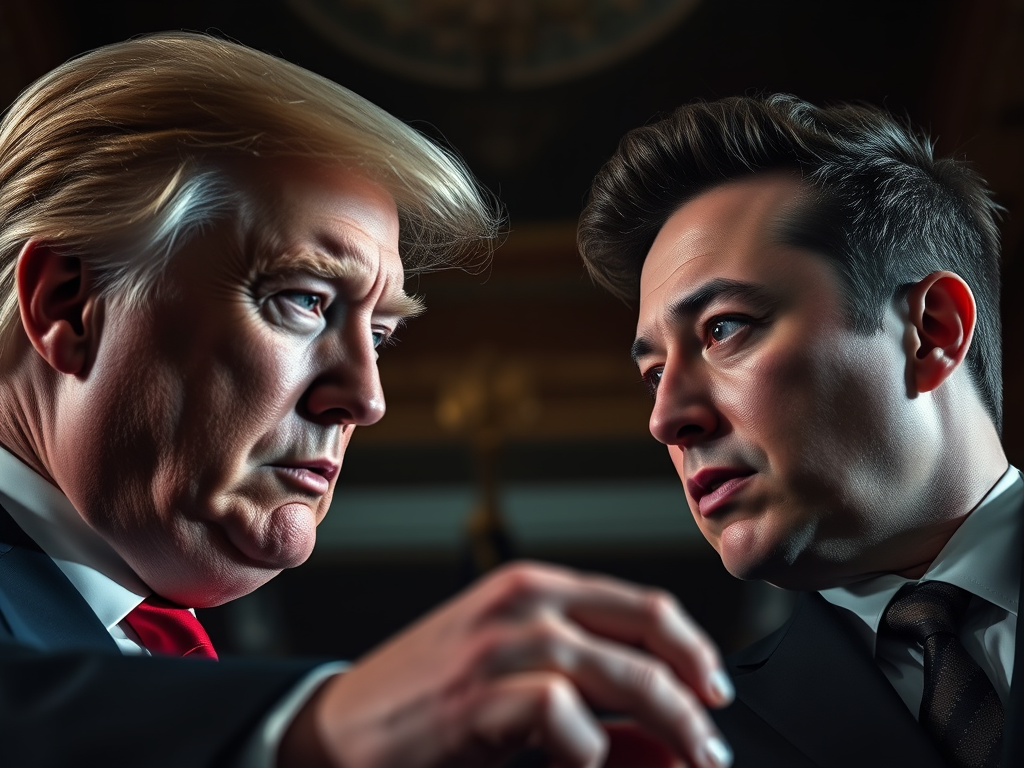
Trump-Musk divorce: Obviously, the big news of the last few days has been the explosive, public, and rage-filled spat between erstwhile friends President Trump and Elon Musk. Surprisingly, the rage is almost all one-sided. Things escalated very quickly from Musk’s initial aversion to the One Big Beautiful Bill Act (and yes, that’s its actual official name) to his accusation on X that Trump “is in the Epstein files” — an insinuation that he was involved in Jeffrey Epstein’s sex-trafficking ring.
That is a very unlikely accusation, by the way, since Musk probably hasn’t seen the files (it is presumed that they are being kept under wraps due to “national security” in order to spare British or other foreign sensibilities), and the Biden administration would have buried Trump with this years ago if there were anything to it.
In any case, although the Trump-Musk drama is fun, the fallout will probably be less dramatic than a lot of people are suggesting. If anything, this may make some Republicans previously wary of the budget bill less likely to keep up their opposition, lest it seem like they are siding with Musk against Trump. Musk is already begging for an audience, and Trump is being uncharacteristically restrained about the whole thing, at least in public — although it has prompted him to dump his Musk-approved nominee to head NASA.
Big Beautiful Bill: The real concern is that there will be collateral damage, and especially that this quarrel will affect the budget reconciliation bill. The bill’s future remains uncertain, but there are a couple of reasons for hope that some version is going to pass.
One is simply that it would be complete electoral suicide for the Republican Party to allow the massive tax increase that will result if nothing passes. House Speaker Mike Johnson has pulled tougher rabbits out of hats for much less politically important causes.
Another positive is that the Senate unexpectedly and unanimously passed a bill permanently exempting lower-income tipped workers’ first $25,000 in tips from taxes. Thanks to the filibuster-proof majority that passed the bill last month, this means that the House can move it separately after budget reconciliation is done with, allowing Trump to keep his campaign promise to exempt taxes from tips without affecting the bottom line.
A third positive is that the White House seems set on using the rescission process to court conservatives. By repealing already-appropriated spending through a separate process that also cannot be filibustered in the Senate, Trump can at least partially offset fears about deficit spending as a result of extending his 2017 tax package.
A side note is that Trump also seems determined to raise the state and local tax deduction cap, a measure that allows mostly Blue tax states to get away with having very high tax rates with fwer consequences. So far, no one is pursuing the strategy we referred to several months ago, of demanding that some Democrats vote for the bill in exchange for that measure’s inclusion.
L.A. riots: Rioters are throwing rocks and bricks at ICE vehicles, lighting cars on fire, and causing general mayhem in Los Angeles. They are attempting to prevent the arrest and deportation of mostly criminal illegal immigrants. But we are now five years on from the summer of 2020, and the public really just isn’t into it this time. The nation’s attitudes about immigration have shifted dramatically in just the last eight years toward support for deportations, recent polls show. Most people do indeed want to see deportations. Trump is the obvious beneficiary of this, since it has always been his signature issue.
Meanwhile, his move of going over Governor and presidential candidate Gavin Newsom’s (D) head and sending thousands of National Guard troops into Los Angeles is a no-brainer in terms of the political optics. It is not without potential drawbacks, but it makes him look tough and the state’s Democrats, who have mostly defended the rioters, look weak.
This sort of thing has potential to shift the mood in Trump’s favor nationwide, but it could also gradually help change the politics of a one-party state that lurched rightward in last year’s election — Trump lost by only 20 points, even though California is Kamala Harris’s home state, after losing to Biden by nearly 30.
Also, random historical fact: The Watts riots occurred in summer 1965 — 60 years ago this August. The following year, Ronald Reagan won a landslide for governor over incumbent Gov. Pat Brown (D).
Governor 2025
New Jersey: Jack Ciatarelli (R) is the favorite to win tomorrow’s Republican primary in a race that suddenly has new relevance. If Georgia appears to be drifting away from them, Republicans view New Jersey as expansion territory — a new swing state. They have had false dawns with Republican governors in the past, including Chris Christie (R), who did little to build up his state’s party. But Trump’s strong performance there (46 percent, only a six-point loss) suggests there is a potential for something more. In fact, between the two states with off-year governor elections this year, New Jersey is probably the more promising one than Virginia.
Democrats’ field is full of credible candidates, and the finish will be far less predictable. Their strongest candidate would probably be the more moderate Rep. Josh Gottheimer (D), but Rep. Mikie Sherill (D) is considered the frontrunner, if only narrowly. Newark Mayor Ras Baraka (D) tried to get on the radar statewide by getting himself involved and arrested in an early May scuffle outside an ICE detention center. There have been no polls of the race since that stunt helped raise his profile, but it’s just the sort of thing progressive Democrats admire nowadays.
Senate 2026
Michigan: An internal poll from one of her competitors suggests that Rep. Haley Stevens (D) is not exactly a prohibitive favorite for the nomination for the open seat being vacated by Sen. Gary Peters (D-Mich.). The survey for State Sen. Mallory McMorrow (D), who came to prominence for delivering what a lot of left-wing Democrats and commentators at least thought was a convincing defense of wokeness in 2022, shows Stevens with just 24 percent, with McMorrow on her heels at 20 percent. McMorrow might suffer from the fact that candidate running in third, Abdul El-Sayed (D), who ran in the primary for governor in 2018, has the backing of such prominent progressives as Sen. Bernie Sanders (I-Vt.) and Rep. Ro Khanna (D-Calif.).
Texas: Amid Republicans’ fight over the Senate race, a George Soros-funded super PAC will be pouring millions into further efforts to turn Texas Blue. You have to admire the perseverance — many commented in November that the efforts to make Texas Democratic again had essentially come to naught. Democrats haven’t won a statewide race in Texas since 1994. But in a close Senate race, perhaps between Attorney General Ken Paxton (R) and former Rep. Colin Allred (D), such a project could make a difference.
Senate 2028
Pennsylvania: Sen. John Fetterman (D-Pa.) could be in for some trouble in his re-election three years from now — or at least that’s what progressives want you to think. The campaign to “Joe Biden” him is well already underway in the media. The stroke Fetterman suffered while running for his current office in 2022 was no obstacle to electing him, but now that he isn’t toeing the line the way they wish he would, his health is an issue.
To be sure, Fetterman is a pretty standard left-liberal on most issues. But his support for Israel and his votes for several of President Trump’s nominees are hurting him badly with the progressive base, leaving him with only a 28 percent approval rating among Democratic voters, according to a new Democratic survey. A primary against him could leave wound him or the eventual nominee and open up an opportunity for Republicans in 2028. Pennsylvania is as swingy as it has ever been. It had two Republican senators as recently as the early 2000s — it could happen again.