The Briefing, Vol. XIII, Issue 3
January 20, 2025
*Inauguration Edition*
This week:
- Reflections on Trump 1.0 versus 2.0
- Biden, Democrats at an all-time low
- Two new faces in the U.S. Senate
Outlook
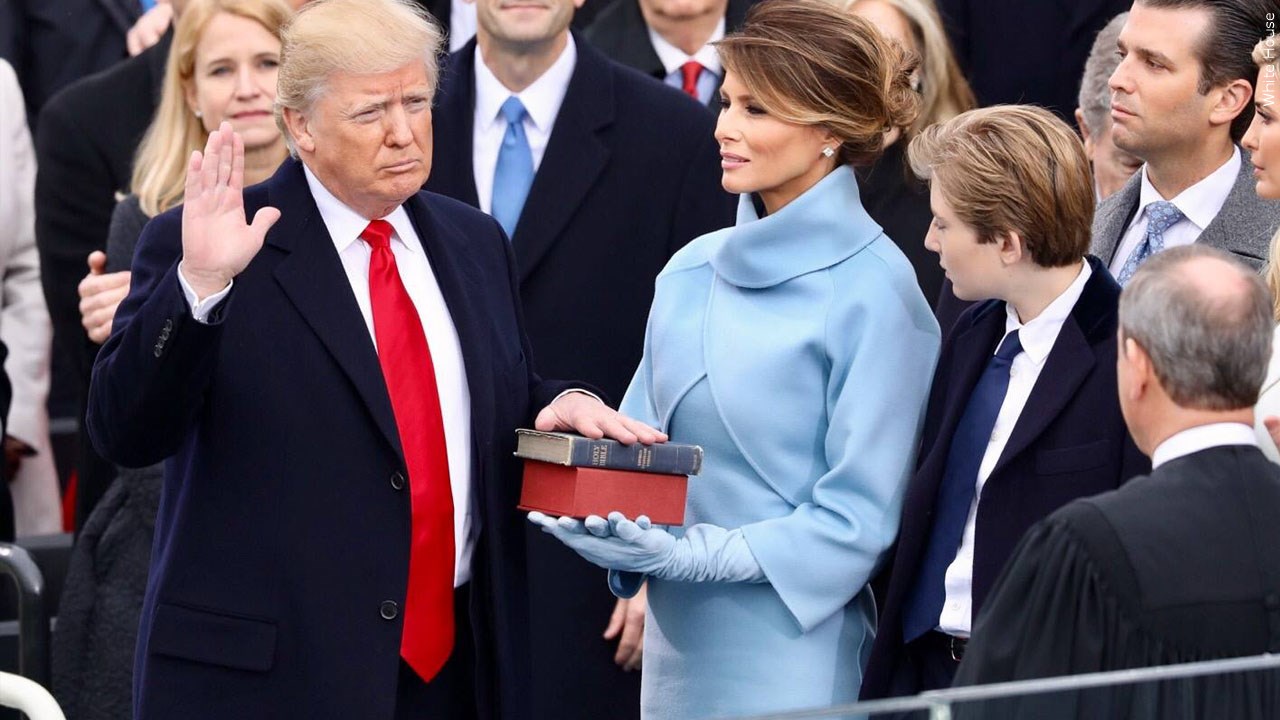
Trump 2.0: Just hours from now, when President-elect Donald Trump takes the oath of office for the second time, he will be presiding over a federal government that is neither mysterious to him nor capable of pulling him down, a massive departure from January 2017.
This time is different, for a number of important reasons.
First, the entire Republican Party is behind him this time. This was not so in 2017. The number who were uneasy or concerned about then but proudly voted for him this time is enormous. In contrast, the number who went Liz Cheney’s route, proudly supporting him and then defecting to the Democrats, is vanishingly small.
The general voting public has also been reassured about Trump, to the point that Trump’s favorable ratings are now as high as they have ever been. And if you ask people why, the answer is kind of ironic. This is not just the result of Biden administration ideological overreach (which it is), but also a result of Democrats’ political persecution of Trump in civil and criminal courts at the state and federal level during 2023 and 2024.
Trump also clearly knows a lot more about Washington now than he did then. Trump 1.0, at this point, was like a sieve, with one damaging leak after another coming out. He was reeling from controversy after controversy due to leaking. For example, recall that the problems regarding Michael Flynn occurred during the Trump 1.0 interregnum. Nothing like that is afflicting Trump at this point. Trump is suddenly running a tight ship. He has clearly become a more disciplined and competent version of himself.
There are many policy plans that Trump has announced in advance that would have caused pearl-clutching and nailbiting in 2017. This time, no one serious will do so much as blink an eye when the mass deportations and the mass yanking of security clearances come down. In fact, Trump probably faces a greater political risk if he fails to go far enough with such measures.
Speaking of which, there are much higher expectations this time. As consequential as Trump’s first administration was in its accomplishments, he will have to produce results this time if he wants to hold his majority coalition together and retain the ability to accomplish anything after the midterm. The clock is ticking for him.
Democrats: If Democrats were a shambles in January 2017, their situation is substantially worse this time around.
As in 2017, they are now a leaderless party. But unlike in 2017, their incumbent president is leaving office with historically low approval ratings — worse even than Trump’s ratings after the Jan. 6, 2021 Capitol riot. Their party as a whole has only 33 percent approval in a new CNN poll — their lowest point lowest since CNN first asked the question in 1992.
Gone is all of the “Resistance” bluster from the Trump 1.0 era. To get an idea of just how badly they have been neutered: Appearing on Meet the Press this weekend, House Democratic Leader Hakeem Jeffries (D-N.Y.) was all double-talk about the idea of mass deportations of criminal immigrants — too timid either to defend Democrats’ sanctuary city policies or to side with Trump.
That is not to say that Democrats are willing to budge where they have to. Almost to a man, House Democrats just voted last week against keeping men out of women’s sports at colleges and universities that receive federal funding. (It is also telling that two Hispanic South Texas Democrats were the only ones to vote for it, but that’s for another day.) The political ads for the next cycle almost write themselves, and this will become even more important when the Senate takes it up. Democrats are already laying the groundwork to underperform in the 2026 midterm elections by voting against a common-sense issue that garners 80 to 90 percent support, depending on what poll you look at.
Another point worth mentioning: Democrats leaned very hard into the “He’s Hitler” rhetoric during the election, and left-wing writers have kept doing so in the time since. They are likely to look a bit foolish when it turns out Trump isn’t Hitler and doesn’t even declare himself dictator and god-emperor in his second inaugural address.
Meanwhile, all efforts to sink even Trump’s more controversial nominees in the Senate seem destined for failure. Pete Hegseth and Tulsi Gabbard, arguably the most controversial nominees remaining in play, look like they will be confirmed, and Pam Bondi will easily sail through as U.S. attorney general.
Additionally, each top Democrat is being forced to defend his or her decision to support or even participate in the cover-up that allowed Biden to stay in the 2024 presidential race as long as he did. It’s an uncomfortable question because it is not just being asked by conservatives any more. Democrats are upset about their loss and want answers, too.
Governance and competence: And finally, as we mentioned last week, in the state now considered to be their ideological homeland and model of governance, Democratic politicians have failed to evade blame for the devastating California wildfires. A public consensus is forming rapidly in Los Angeles that they are being governed by idiots.
Although it is only tangentially related, longtime Democratic author Joe Klein penned a blistering and lengthy substack post (which is worth reading in its entirety), arguing that their party suffers from a much deeper malady than just its ideological excesses in the nonsense of identity politics and pro-criminal policies. Before they went fully overboard in those departments, they had already surrendered themselves completely to a union-bureaucrat class that has been making life almost unlivable for those under Democratic governance.
This is not exactly a new problem, but specific incidents of late (including COVID restrictions, the border crisis, the shoplifting epidemic in California, and now the fires) have brought it to the forefront in a way it just wasn’t before. People are upset about the quality of public services they are receiving, and they are more upset the higher the taxes they are paying for those services. This explains why Trump performed so much better in 2024 in urban areas and blue states. It also explains why the populations of California, Illinois, and New York are all in decline, whereas Texas, Tennessee, Florida, and Idaho are booming.
As Klein writes: “The Democrats stand for every overweight postal worker who can’t be bothered to put your mail in your slot. And they stand for every teacher who leaves parent-teacher night at the stroke of nine, even if parents are waiting to meet, because the contract says you can leave at nine. And the Democrats stand for all the schools that remained closed during Covid, and for all the regulations that forced barber shops and other small businesses to shutter, at the risk of their livelihood, and they stand for every public school janitor who only mops the cafeteria floor once a week — because that’s what the contract says.
“And can you blame the public if it extrapolates? If the government can’t keep the water flowing to fight fires — or can’t wade through the red tape to get dams and ports and airports and highways up to international standards, and allows crazy people to toss my aunt onto the subway tracks, and can’t seal the southern border, and have allowed an infestation of shoplifting so severe that Tylenol has to be kept under lock and key at my CVS, why should we trust them with the White House?”
Klein’s essay represents the kind of savage introspection that most of the Democratic political establishment just can’t handle right now. If you listen to the candidates for DNC chair, they will tell you their party has a communications problem — that the media failed to get the message out about how great life was under Joe Biden. That’s their excuse, even though Democrats have had a near-monopoly on mainstream media narratives at every moment of this century.
If Democrats do have a communications problem, it is that their ideology has become indefensible any environment where they lack 100 percent narrative control. All it takes is for someone like Elon Musk to stop ruthlessly censoring and banning inconvenient stories and conservative perspectives on social media, and the Democrats’ entire world comes apart at the seams — which is exactly what’s happening to it now.
Senate 2026
Florida: As expected, Gov. Ron DeSantis (R) has appointed attorney general Ashley Moody (R) to the U.S. Senate to replace Marco Rubio, who will easily receive confirmation as Trump’s new secretary of State. This was supposed to develop into a drama in which DeSantis was under pressure from Trump to appoint his daughter-in-law, but that entire narrative fizzled when she removed herself from consideration.
Moody will face a special election in 2026.
Ohio: Gov. Mike DeWine (R) made a more surprising choice by replacing Vice President-elect JD Vance in the U.S. Senate with his own lieutenant governor, Jon Husted (R). The conventional wisdom said that Husted wanted to run for governor instead, but now, assuming he wants to stay in office, he will run in a special election to keep his Senate seat.
As a side note, Sen. Bernie Moreno (R) has become Ohio’s junior senator after just a week on the job. Compare that to the late Sen. Fritz Hollings (D-S.C.), who had to serve for 36 years and two months before he became his state’s senior senator.