The Briefing, Vol. XII, Issue 21
This week:
- Biden thinks the polls are all rigged against him
- Don’t blame the messenger, Joe!
- Hogan’s abortion gambit
President 2024
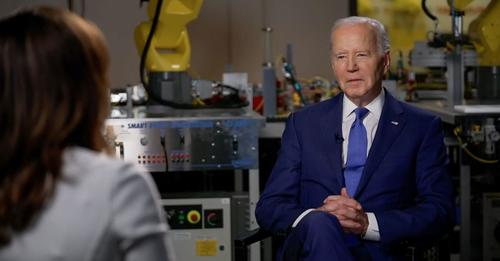
“The polling data has been wrong all along,” President Biden said in a recent interview with Erin Burnett. “You guys do a poll at CNN, how many folks do you have to call to get one response?”
This was his curt answer to Burnett’s simple observation that the polls, on aggregate, mostly show him losing this election. To be sure, Biden has good reason to be upset — he really is behind in nearly every poll. But he shouldn’t be upset with the pollsters. They didn’t put him in this situation — he put himself there.
Polling conspiracy? Is there any merit to Biden’ right ‘s claim in his CNN interview that the polls are all wrong? No single poll can be taken as infallible. However, to put it bluntly, it’s hard to believe that all of the polls would systematically and grossly underestimate Biden.
Unless you believe in a massive conspiracy theory that involves collusion between pollsters — a conspiracy at least as big as Trump’s assertions that the 2020 election was rigged — it is impossible to believe that the nation’s multiple pollsters, with few exceptions, are all so badly wrong.
Keep in mind that, in the past, when national polls have underestimated Trump’s chances of winning, they were still generally correct in predicting that both Joe Biden and Hillary Clinton would receive more votes nationally than Trump did.
So what to make of Biden’s complaint?
Never mind that many of these pollsters (Siena in particular) are being contracted by media networks and publications with very strong anti-Trump biases, sometimes bordering on derangement. And also set aside that, historically, Trump as a candidate has performed better than his polling. The fact is, they can’t all be faking it to make Trump look better like this unless they are actively colluding to do so behind the scenes — that is, engaging in a conspiracy. It just isn’t even reasonable to believe that such a thing could or would happen. Biden is therefore alleging a massive conspiracy theory, something for which more Republicans probably ought to be calling him out.
Volume of evidence: We have mentioned this before, but take a moment to consider the current electoral situation this way: In 2020, Donald Trump led or tied Joe Biden in just five out of the 230 national polls posted on RealClearPolitics between Jan. 1, 2020, and the November 2020 presidential election.
Trump never posted a consistent lead at any point in that race. In spite of this, Trump came within a hair’s breadth of winning in November 2020. Flip just 21,500 votes across three states (Georgia, Arizona, and Wisconsin), and Trump would be in the middle of his second term right now.
This time, in 2024, Trump has led or tied Biden in 69 of the 92 national polls taken so far between Jan. 1 and today. Trump leads or is tied in 9 of the last 12 national polls as of the morning of May 20, 2024. This time, Biden leads in just 24 out of those 92, or about one-fourth.
Yes, polls can be wrong. But incumbents tend to lose if they are even tied, let alone trailing in the polls. Biden’s chances therefore appear to be significantly worse this time based on that fact alone.
State-by-state: There’s an even simpler and more precise way of thinking about this, based on the realities of the Electoral College, that should drive the point home even harder. National polls don’t really matter, especially given a candidate like Donald Trump, who has shown twice that he can win the presidency without winning the national popular vote.
The most alarming thing for Biden’s campaign has to be that he has not led in any poll of Arizona, Nevada, North Carolina, or Georgia at any point in this calendar year (or in Georgia’s case not since 2022). So give those states to Trump, plus all the states he carried in 2020, and you get a map that looks like this (image courtesy of 270toWIN.com):
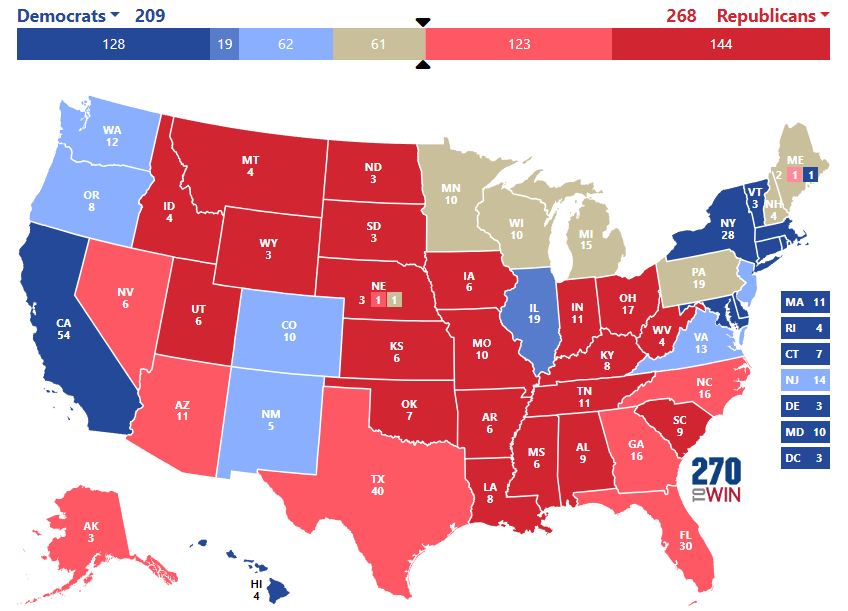
Note that in this map, Trump has 268 electoral votes. If he gets just one more vote — 269 — that will result in an Electoral College tie. That would send the election to the U.S. House, where Trump would very likely win, due to the one-state-one-vote process used in the House to choose the president.
There are 61 unallocated electoral votes in this map. In order to win a second term, Biden has to win 61 out of those 61, since it is unlikely that he will be able to put any “Red” states in play.
It is at this point that one begins to appreciate how hopeless Biden’s situation really is.
Before we even look at the so-called “Blue Wall” states, Biden will have to hold a congressional district in Nebraska which, in its current configuration, went for Biden by only about six points.
If he manages that — and it is entirely possible that he will not — he will still have to overcome what appear to be polling deficits in Pennsylvania (Trump +2.0 in the RealClearPolitics average) and Wisconsin (Trump +0.6). Then he will have to defend Michigan (Trump +0.8 but with a less consistent lead) and Minnesota (Biden +2.3). In addition, he will have to make sure he doesn’t lose too much ground in Maine, where two electoral votes are at stake for the statewide winner, or New Hampshire. Polling in these states is sparse, but things could potentially get far more interesting in them than Biden can afford.
Furthermore, Biden has to prevent Trump from putting additional Blue states (such as Virginia, Colorado, New Mexico, or even New Jersey) into play, or he is simply done for.
What you will notice about this map is that Biden is fighting an entirely defensive battle. He is not winning new states, just as he appears not to be winning new voters. All indications are that constituent members of his coalition (young voters, Hispanics, black voters, etc.) are falling away from Biden at the margins. So are the states that he relied on to carry him in 2020.
In short, it’s only May, yet Biden’s path to re-election has already become disturbingly narrow for him.
Senate 2024
Arizona: The latest poll that shows Trump with a five-point lead in Arizona also shows likely Senate nominee Kari Lake (R) losing by seven points. There is therefore no chance that the poll can be dismissed as skewed toward Democrats, since this is one of the better surveys for Trump.
Lake is almost universally known in the state after her losing 2022 bid for governor. Moreover, Lake consistently led in polls that year before losing and putting on a sore loser act that probably has not endeared her to the state’s voters.
Maryland: Can a Republican win in liberal Maryland by cozying up to the abortion lobby and embracing all-nine-month abortions? We’re about to find out.
Freed from the constraints of being a candidate in a primary, former Gov. Larry Hogan (R) now says he supports legislation “codifying Roe,” which would in effect knock out all or nearly all state laws on abortion. He faces Prince George’s County Executive Angela Alsobrooks after she won her extremely expensive and “bruising” primary against Rep. David Trone (D).
This kind of liberal Republicanism is not unprecedented, of course. In fact, it was a lot more common 20 years ago, when Sens. Susan Collins (R-Maine), Lisa Murkowski (R-Alaska), and former Sens. Olympia Snowe (R-Maine) and Lincoln Chafee (R-R.I) were all serving at the same time. But if even this doesn’t help Hogan, then it goes a long way toward explaining how the “RINO” became an endangered species.