The Briefing, Vol. XII, Issue 10
This week:
- The most anticlimactic Super Tuesday in decades
- Biden is imploding among Hispanic voters
- Garvey surges in California Senate race
Presidential primaries: With today’s Supreme Court ruling (unsigned, but apparently unanimous) that state-level Democratic officials cannot simply throw Donald Trump off the ballots in their states, we finally arrive tomorrow at the Super Tuesday presidential primaries.
And no one even cares, because the outcome is a foregone conclusion.
The nominations for both major parties are essentially settled. Usually, at this point, at least one of the parties still has a serious nomination contest on its hands, but not this year. The U.S. political scene hasn’t seen anything like this double-coronation since 2000. And that’s not quite accurate, because even in that dull primary year, John McCain (R) showed a bit of life by defeating George W. Bush in New Hampshire, and Bill Bradley at least made life challenging for Al Gore (D).
Barring his resignation, a Democratic Party internal coup d’etat, or a revolt by his own delegates at this summer’s convention in Chicago, Joe Biden is locked in as the Democrats’ candidate. Although his replacement on the ballot is technically possible, we do not view it as a likely scenario. As we have put it repeatedly, they are stuck with him.
Meanwhile, Donald Trump, having convincingly defeated former Gov. Nikki Haley in her own home state, and having beaten her since then in nominating contests in Idaho, Missouri, and Michigan, has earned more than five times as many delegates for this summer’s convention in Milwaukee and is widely expected to run the table tomorrow.
Trump versus Biden: This should all have Democrats very concerned, because Trump has led Biden in 18 out of the 22 polls published since February 1. As we have previously pointed out, Trump led Biden in only two out of more than 200 polls published throughout the entire 2020 election, yet he still came within a hair’s breadth of winning an Electoral College victory. This time, a popular vote majority (or plurality) is not at all an unreasonable goal for Trump.
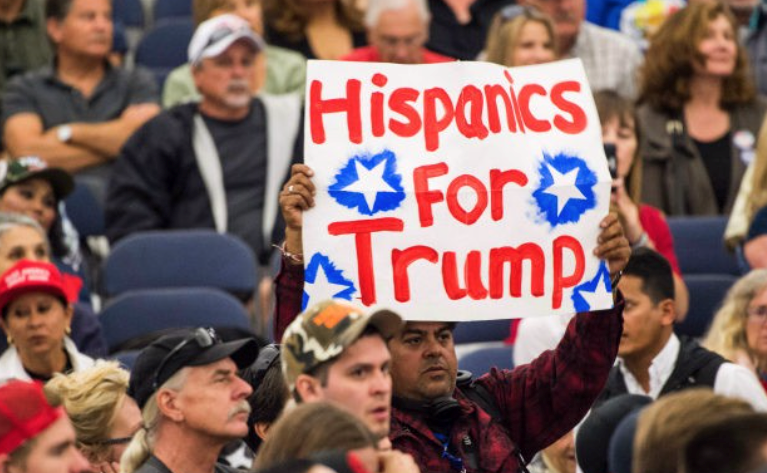
The even worse news for Democrats, however, was buried in the New York Times poll released over the weekend. It shows Trump leadings Biden by five points, but it also showed Trump tying Biden among women (at 46 percent), winning an impressive 23 percent of the black vote, and winning by six points among Latinos (46 to 40 percent). The CBS News poll that also came out this weekend also showed Trump winning 46 percent among Hispanic voters. That would represent a massive gain over what he won in 2020, although that poll has Biden with 53 percent of Hispanics.
Win or narrowly lose, these Hispanic numbers will make Trump president again, and may indeed be the key to the Republican Party’s entire future. Even the disappointing 2022 election results pointed to a realignment that seems to be ongoing and could cost Democrats one of their most prized constituencies.
Most liberals associate Trump with his unkind comments about immigrants. They also crudely associate Hispanics with the immigration issue, even though most Hispanic voters are not even immigrants.
The key is this: Demographically, Hispanics are more similar to working-class white voters than they are to any other group. Indeed, the Census considers them white, and a majority of Hispanics (53 percent, according to this same poll) consider themselves white. On aggregate, they tend to believe far too much in family values and Western ideals to support today’s Democratic Party in such great numbers for much longer. They are also largely opposed to illegal immigration, and, at least in Texas border towns, highly resentful of the influx that is currently overwhelming many of their communities. This is part of the reason Hispanic voters give Biden only a 31 percent approval rating in this poll, which is even lower than white voters (35 percent).
This is why South Texas has suddenly started electing Republicans. It’s also a reason Arizona and Nevada can perhaps start to be turned around this year.
Republicans suddenly began winning elections at all levels in Southern states in the 1990s, when Southerners decided en masse that it was finally okay to vote Republican. This is exactly what is happening now among Hispanic voters in many states across the Sun Belt.
For liberals who ignore these realities, Trump’s popularity among Hispanics is some kind of paradox or riddle. But for anyone who has been following the trends, it is very clear why Trump has made so much progress in winning over Hispanic voters, where earlier immigration-focused attempts by George W. Bush and others fell flat.
Another note about Hispanic voters in this poll: They are just like everyone else in their strong feelings about Trump. Although Trump wins more Hispanic support than Haley (she beats Biden with 43 percent), Hispanic support for Biden shoots up from 31 percent if he is running against Haley to 40 percent if he is running against Trump. In short, even though more of them support Trump, there’s a strong undercurrent of Hispanic voters who intensely dislike him.
Senate 2024
California: Thanks to the crowded primary field, it now appears that Republicans might get a statewide candidate on the November ballot.
The top two in tomorrow’s primary, regardless of party, will advance to the general election. Baseball great Steve Garvey (R) looks likely to finish in first place, with Congressman and Trump nemesis Adam Schiff (D) closely behind. The new L.A. Times poll has Reps. Katie Porter (D) and Barbara Lee trailing with 19 and 12 points, respectively, as Garvey takes 27 percent and Schiff takes 25.
House 2024
Missouri-1: Although the primary won’t be held until August, Cori Bush (D), the embattled leftist congresswoman from St. Louis, found herself in third place, trailing her primary opponent Wesley Bell by 22 points in a Missouri Scout poll released a couple of weeks ago. That is quite bad for an incumbent, and it points to a likely future loss.
Bush has since come under federal investigation for possible campaign finance violations related to extremely high payments for security services, including to her own husband. It should be noted, however, that Bush would not at all be alone among members of Congress who have used campaign money to enrich family members.
Ohio-9: Republicans caught a bit of a break when J.R. Majewski (R) opted not to run again in this Toledo-area seat that Trump carried in 2020. He denied rumors that Trump had asked him to drop out, since he had turned into a bit of a lightning rod for controversy and unperformed expectations in 2022.
Majewski had been attacked in 2022 for misrepresenting his military service, and more recently he was criticized for using the word “retarded” to describe Special Olympics participants in a podcast.
Texas-18: Keep a close eye on this race tomorrow, where 15-term Sheila Jackson-Lee could narrowly lose renomination to her former intern, former Houston Councilwoman Amanda Edwards (D).