Republicans hold out hope of beating Virginia’s gerrymandering referendum

The Briefing, Vol. XIV, Issue 14

April 6, 2026

This week:

  • Bondi fired
  • Trump gets a boost from jobs data, Iran rescue
  • Can Republicans beat Va. gerrymandering referendum?

Outlook

Bondi out: What had up to now been a surprisingly stable administration is suddenly starting to lose its first round of Cabinet alumni.

The sudden departure of Pam Bondi as attorney general comes after a year of complaints from Trump’s base about her handling of the Jeffrey Epstein files, as well as a perception that wrongdoing by Biden-era officials is going unpunished. 

That latter perception may be unfair, as we do not know what sort of investigations are actually underway, if any. Unlike in state criminal investigations, the feds tend to arrest people only after building the entire case against them and listening to their phone calls for months. Also, several federal indictments that fall in the “retribution” category have failed at the grand jury level — it may just be that the grand juries in DC and Northern Virginia are too political, or that the MAGA thirst for retribution outstrips the level of evidence available in some of the intended prosecutions.

Bondi’s firing comes just as the earlier removal of Kristi Noem as Homeland Security secretary broke open with humiliating new revelations about her husband’s alleged perversions. That unfortunate story rounds out a dysfunctional picture that includes the longstanding allegations that Noem has been carrying on with Trump campaigner Corey Lewandowski, whom she had hired into DHS.

In the end, Trump seems to have painlessly cut off two of his weaker Cabinet picks with a minimum of acrimony. Although neither one has a political future, both at least leave office with serious enough accomplishments to save face — Noem in the unprecedented securing of the southern border, Bondi with respect to plummeting levels of crime across the country. This is especially true in Washington D.C., where federal prosecutions play an outsized role. As of today, D.C. is on pace for just 41 murders in 2026, which would apparently be the lowest number on record.

Jobs data: The jobs numbers for March 2026 were significantly above expectations — a needed shot in the arm for President Trump at a time when his approval numbers are lagging

The addition of 178,000 jobs to the overall economy significantly outstripped the expected 59,000. This occurred in spite of a drop of 18,000 jobs in the federal government, bringing federal civilian payrolls to their lowest level since May 1966.

Wages were up 3.6 percent, which is not that bad, and unemployment fell to 4.3 percent — and of course, it’s always good to see that number go down, even though economists will say that anything below 5 percent is full employment, with a minimum number of people seeking new jobs at the margins. 

It is again noteworthy that the absolute numbers of jobs created are smaller now, and there are a few good reasons for this. The main one is the massive Baby Boom generation retirement now picking up, leaving fewer workers in the job market. (One side-effect of this is that the main growth industry for jobs is in health care.) A second one is the abrupt halt in illegal immigration across the southern border. With the employment-population ratio already roughly as high as it has been in about 25 years for career-age workers (25 to 54 years old), the economy simply does not need to create as many jobs to maintain full employment.

Still, full employment is not a panacea. The Biden administration also enjoyed full employment and rising wages for most of his term, amid the recovery from the pandemic. That didn’t stop the discontent that caused him to lose control of the U.S. House in 2022 and ultimately sealed his fate as a one-term president, whether or not he ran for re-election.

Aside from his border problem, which Trump does not have, and an inflation problem that had mostly ended before Biden left office, the other major problem the former president had occurred when he abruptly and chaotically abandoned Afghanistan. In polling, that event in late summer 2021 marked a permanent loss of trust for Biden because it evinced a true competence problem within his administration. His approval rating never recovered.

Iran war: With the Iran conflict, Trump faces a similar test to Biden in Afghanistan. The jury is still out on whether he will pass or fail.

Some pundits are already talking about the air war in Iran being “lost” or becoming “a quagmire” after a mere month of fighting. Even more absurdly, they are saying these things after a month of almost continuous U.S. military successes in dismantling Iran’s warmaking capabilities, with minimal U.S. casualties and material losses after tens of thousands of sorties by U.S. and Israeli forces. 

Such talk is, of course, preposterous. Although 13 servicemember deaths and hundreds of injuries is not nothing, one simply does not enter a conflict like this one expecting such low numbers. The real debate is and always will be whether the war was justified in the first place. People will continue to disagree about that long after it is over, even if the political question for those persuadable will be whether it is going well.

But as it always goes when a presidential administration begins a war, it carries the burden of justifying it, and of doing so convincingly. In this case, the Trump administration’s argument is simple, even if poorly articulated. Iran’s nuclear and missile capabilities were about to become unmanageable for any future presidential administration, and so, the reasoning goes, the only course of action is to prevent that through military action. A permanently untouchable Iranian regime ruins any future chances of peace in the Middle East — not just for Israel but also for the Sunni Arab countries and the many nations in which Iran’s proxy militias are causing havoc. 

For this reason, a severely militarily degraded Iran is an acceptable outcome for President Trump, even without regime change — and this is important, because so far there is little evidence that regime change is really on the cards.

Still, perceptions matter. What Americans perceive most clearly at this point is that their gasoline prices have risen by more than a dollar a gallon. That does not bode well for Trump, but it isn’t as catastrophic as the Iranian propaganda victory would have been, had Iran captured either of the U.S. airmen shot down in recent operations..

For that reason, the dramatic rescue of two downed airmen inside Iran serves as a much-needed lifeline for the Trump administration as the conflict Trump chose enters its second month. Had the U.S. failed to rescue both airmen from the downed F-15E inside of Iran, it could have dramatically turned the tide against the Trump administration. The politics of the situation could have even forced Trump to come to a humiliating settlement with an enemy he has largely defeated.

For now, a mostly-defeated Iran has only two good cards left — both of which it also had before the conflict started. The first is its nuclear material. The second is its ability to close the Strait of Hormuz to enemies’ shipping in the long run. 

Although Hormuz is a key chokepoint in world commerce, neither Israel nor the U.S. has much of a direct stake in shipments through the strait. Israel gets most of its petroleum from Central Asia and Africa. The U.S. is the world’s largest producer and exporter. Oil is a global commodity, and so where the oil goes is of less importance than many people assume. Even if it goes to Europe, China, India, or elsewhere, the resumed flow of oil will tend to bring world prices downward.

As for the nuclear material, there is still talk of using special forces to seize and destroy it. But unless Trump plans to take such a bold step — and there would be enormous casualty risks involved — the politics of the situation continue to dictate wrapping up the war as quickly as possible.

Senate 2026

We reached a turning point last month in the futures markets: They are now almost evenly split on which party will control the U.S. Senate after the coming midterm elections — slight advantage for Democrats as of this writing.

Florida: A new Emerson survey — the first poll of the race so far — suggests that former Trump impeachment figure  Alex Vindman’s (D) high-profile and well-funded challenge to Sen. Ashley Moody (R) will still be a serious uphill climb. Moody, a former state attorney general who was appointed to replace Marco Rubio in the Senate, leads him 46 to 38 percent, and holds similar leads against other Democrats in the race. 

Although 46 percent is not necessarily a great number for an incumbent, the poll also suggests that Moody has a lot of room to grow, as 36 percent of respondents still haven’t heard enough about her to form an opinion. Opinions about President Trump’s performance are almost evenly split in the poll, and lame-duck Gov. Ron DeSantis (R) enjoys a plus-ten approval rating.

Florida’s primary is August 18.

North Carolina: Former Gov. Roy Cooper (D) continues to hold a convincing early lead over the Republican nominee, former RNC Chairman Michael Whatley (R). A Quantus Insights poll from last week shows a five-point lead.

House 2026

Virginia: Dare Republicans hope? A new Washington Post poll suggests that Democrats’ partisan gerrymander referendum is only just barely squeaking by, 52 to 47 percent, even though the “Yes” campaign has outspent “No” by a ratio of 14 to one. Based on early turnout in Republican areas, Republicans are reportedly “cautiously optimistic.” The last chance to cast a ballot is coming up on election day, April 21.

If the referendum fails to pass, Democrats will face a marginally more difficult task in taking control of the U.S. House in November’s election.
The last government shutdown?

The Briefing, Vol. XIV, Issue 13

March 30, 2026

This week:

  • Are government shutdowns a thing of the past?
  • Trump’s win-win approach to TSA funding
  • Maine’s Graham Platner trouncing sitting Dem governor in another primary poll

Outlook

End of shutdowns? As a Senate deal to fund TSA fell through and both houses of Congress adjourned for a two-week recess, President Trump signed an executive order for Secretary of Homeland Security Markwayne Mullin to pay TSA’s airport screeners using emergency funds, regardless of what Congress does. 

This measure aims to address the immediate crisis of four- to five-hour-long lines forming at some airports such as Houston, Atlanta, and JFK in New York. (Not all airports were so badly affected.) Trump’s initial move to ameliorate the problem was to send ICE officers — who are still being paid separately under last year’s One Big Beautiful Bill Act — into airports to supplement the efforts of those TSA agents who have been showing up but going without paychecks for more than a month now. 

This outside-the-box thinking — apparently originally the idea of a caller to the Clay and Buck Radio Program — has not only shortened lines significantly but has also already had unexpected political benefits. For example, it helped humanize immigration officers, who mostly just showed up at airports to perform simple tasks such as checking IDs, handing out bottles of water, and in some cases even offering to stand in line for passengers while they went to use the restroom.

Democrats’ rationale in the current shutdown is somewhat muddled. Their goal is to “reform” immigration enforcement — that is, to force ICE and the Border Patrol to stop enforcing immigration laws. But those agencies are already funded. Their hostages are unrelated agencies that depend on annual appropriations — TSA, yes, but also FEMA, the Coast Guard, the Secret Service (formerly part of the Treasury until 2003), and a handful of other alphabet agencies with lower profiles. Several of these are essential to security, and they are unfunded at a time when Trump has thrown down the gauntlet against the world’s number-one state sponsor of terrorism.

An unconventional order: Now Trump has ordered that TSA workers be paid. This move may seem like a massive departure from the norm — and it is, at least from the practice of the last 46 years. But importantly, it is not at all unusual in our nation’s history.

Take a step back to before 1980, and there were no government shutdowns at all. It was only when Carter-era Attorney General Benjamin Civiletti issued an opinion about a previously obscure 19th Century Law called the Antideficiency Act. His new and strict interpretation of the law meant the government could no longer expend funds during shutdown periods, including even the wages owed to essential government employees.

Prior to that, things worked differently. As Government Executive’s Tom Shoop put it in 2022: “For nearly 200 years of the country’s history, this never happened. Everyone just assumed that if Congress didn’t get around to finishing appropriations bills, then agencies would just continue operating as normal until lawmakers got the job done.”

You can probably see where this is headed. If shutdowns are a choice by a single attorney general, then there is a very plausible legal argument that they are unnecessary. By simply repudiating a modern (45-year-old) interpretation by an attorney general, Trump could put an end to one of the most ridiculous parts of U.S. governance — the endless lurching by fits and starts between one budget crisis and the next. 

Although he hasn’t gone to this extent just yet, it is surely the easiest way to justify his current action.

Short-term and long-term benefit: In the present situation, this order has an added political benefit: If Democrats want to stop it, they must challenge Trump in court to take away paychecks from TSA workers, many of whom make less than $50,000 per year. This won’t be like defunding ICE or the police — entities easier to demonize in the eyes of their base. It will be more like stealing from low-income and unskilled workers.

And of course, what makes this most politically suicidal is the reason why they would be going after these TSA workers’ pay: in order to return to the Biden immigration policy of flooding the U.S. with as many illegal and unvetted aliens as can show up at the border, and give them a right to stay in the country for as many months or years as they can avoid getting caught for murder or some other egregious crime. 

Certainly this would not guarantee political losses for Democrats, but it would certainly improve the chances of a Republican Party facing a very difficult midterm environment. The campaign ads nearly write themselves.

The more important long-term effect would be to abolish shutdowns as an instrument of hostage-taking. This is something both parties have advocated for at some point, often on a bipartisan basis, and it is already easily within reach, without need for legislation.

One of Trump’s superpowers in both terms has been to say and do things that other people wanted to say or two but lacked the will for. That includes everything from operationally closing the border to ramping up crime prevention in D.C., to calling China’s treatment of the Uyghurs a genocide, to trying to end birthright citizenship by order (although this will probably fail), to moving the U.S. embassy to Jerusalem, to striking Iran’s nuclear capabilities. There are at least a dozen other examples, and in most cases Trump comes off looking good for acting boldly. 

Senate 2026

Maine: Despite what the polls keep saying, it seems increasingly likely that Democrats will not be putting their best foot forward in this race.

A new Emerson survey has controversial oyster farmer Graham Platner (D) leading Gov. Janet Mills (D) by a very long way — 55 percent to 28 percent. Both lead incumbent Sen. Susan Collins (R) in hypothetical head-to-heads at this point, and Platner by much more. A Mills-Collins race clocks in at 46 to 43 percent, whereas the poll has Platner leading Collins, 48 to 41 percent.

At least, that’s where things stand now. But Platner, for a variety of reasons, will be a much easier target in a general election thanks to his long history of erratic online and offline behavior. For now, ardent leftist zeal for his candidacy in a Democratic primary is likely masking the dangers Democrats will face if they nominate him.

Primary day is Tuesday, June 9.

House 2026

Florida-20: Speaker Mike Johnson (R-La.) has earned a reputation for effectiveness by shepherding multiple controversial pieces of legislation into law, despite the slimmest of margins in the U.S. House. But for once, he may soon get a bit of breathing room. 

The House Ethics Committee just tried Rep. Sheila Cherfilus-McCormick (D-Fla.) last week and found her guilty of 25 of the charges against her, which involve massive multi-million-dollar COVID fraud for which she is also under indictment. Cherfilus-McCormick is, of course, innocent of the charges until proven guilty in a law court, but that won’t necessarily stop her colleagues from expelling her from the House, much like they expelled former Rep. George Santos (D-N.Y.) in 2023.

More than half a dozen House Democrats already appear likely to cooperate in her removal from the House, and so the clock is ticking on her political career. If she resigns or is removed, it probably guarantees her heavily Democratic seat will remain vacant until the end of the summer, when all legislative activity will be over for the election season.

Detroit News – Cox: James Lying About Trump

Source: Detroit News (The article below is from The Detroit News)

Barrage of ads hit GOP race for governor

A rush of commercials from the Republican candidates for governor and their supporters hit the airwaves last week.

State Senate Minority Leader Aric Nesbitt of Porter Township debuted his first TV ad of the campaign, saying “dirty jobs” he did on the farm growing up prepared him to “drain the Lansing swamp.”

“There are a lot of rich guys running for governor,” Nesbitt says in the ad. “Me? I grew up shoveling … and castrating hogs on the farm.”

At the end of the 30-second spot, Nesbitt concluded, while holding two pigs, “Liberals might squeal, but we’re taking Michigan back.”

One of the “rich guys” in the Republican primary race, millionaire businessman Perry Johnson of Bloomfield Hills, launched his latest round of ads, running during NCAA basketball tournament games and putting $1.5 million behind it.

Johnson says, in the new ad, that it’s logical for boys to play with boys and girls to play with girls in youth sports.

“Woke left radicals,” according to Johnson, want to allow sex changes for minors.

“I’m a conservative businessman and thankfully, an outsider to politics. I don’t owe anyone anything, other than trying to bring sanity back to our state,” Johnson says in the ad.

Meanwhile, Mission Michigan, an organization that’s backing U.S. Rep. John James of Shelby Township, sponsored ads last week that featured clips of President Donald Trump speaking positively about James at past campaign events.

“He’s going to be a star,” Trump says in one of the clips from a past rally.

Former Attorney General Mike Cox of Livonia blasted the Trump-focused ad in a statement Friday, arguing that it falsely suggested James has Trump’s endorsement.

Trump has not endorsed in Michigan’s Republican primary for governor.Mission Michigan’s donors include Dan DeVos and his wife, Pamella DeVos, who gave a combined $5 million to the pro-James group last May.

For Cornyn, the math is still not adding up

The Briefing, Vol. VIV, Issue 12

March 23, 2026

This week:

  • Trump still looking to wrap up in Iran
  • Cameron loses altitude in Kentucky Senate primary
  • Math still not adding up for Cornyn

Outlook

The air war in Iran, launched at the end of February by President Trump and Israeli Prime Minister Benjamin Netanyahu, is at this point starting to bite U.S. consumers with high gas prices. Although this is definitely a first-world problem, the Trump administration seems quite sensitive to the idea of four dollar gas (it’s actually closer to $6 in California, but that’s a local problem). Trump has responded to this with a number of measures — most notably by suspending the protectionist Jones Act so that non-U.S. ships can carry oil and gas directly between U.S. ports. This is yet another policy step conservatives have long desired, but they never expected that the tariff-loving Trump would be the president who took it. The Trump presidency keeps proving to be full of surprises.

Although Iran has been essentially defeated militarily, it still retains the advantage we have consistently pointed out: The rules of the game are stacked heavily against anything like a clear U.S. victory, and that poses a political threat to Trump and his party in a midterm election year where the environment is already tough. 

Iran does not have to shoot down a single U.S. aircraft or retain any of its military capabilities after the conflict ends in order to plausibly claim victory in this fight. Its regime only has to survive, even if it does so as a husk of its former self. It can continue applying pressure as long as it can create any amount of extra risk in the Strait of Hormuz and strike its neighbors’ civilian infrastructure.

If this conflict has been reassuring in any way, it is because the U.S. military has vindicated its existence. It is not a comically bad, overrated force like Russia’s has proven to be in its stymied Ukraine invasion. It is an unparalleled fighting force capable of joint operations like no other. Its only peer world power, China, has to be very concerned about how effective U.S. forces are, and about how poorly its own weapons and defense systems have fared in recent conflicts in the hands of Iranian and Venezuelan operators.

That said, the Chinese regime doesn’t have to worry about elections. Trump does, and every day the Iran conflict continues, he risks a second half of his second term in which Democrats have the power to investigate and impeach him ad nauseam.

Along those lines, there is also no end in sight to the Homeland Security funding standoff. Democrats refuse to fund the agency unless they can get under the hood and dictate how the multi-year immigration enforcement funding, already approved as part of last year’s reconciliation package, is used. This means potentially longer lines at airports, since TSA falls under this category. So does the Coast Guard and FEMA, so there could be political consequences in the event of a natural disaster. Trump’s announcement that he will simply staff airports with ICE agents suggests he is willing to ride out the controversy.

Governor 2026

Iowa: Former six-term Gov. Terry Branstad (R) has endorsed northwestern Iowa Rep. Randy Feenstra (R) in the crowded primary to succeed Gov. Kim Reynolds (R) in a race that will test Republicans’ newfound dominance of the Hawkeye State. There is no polling at all in this race, but Feenstra represents the state’s district with the heaviest concentration of Republicans and conservatives.

Senate 2026

Illinois: The polls were not trustworthy. In a state where organization has historically beaten slick media campaigns, Lt. Gov. Julianna Stratton (D) won the U.S. Senate primary despite trailing in every poll and being outspent. 

Kentucky: Yet another poll, released last week, suggests that the May 19 Senate primary in the Bluegrass State is one the hottest tickets on the Republican side this year. Former Attorney General Daniel Cameron (D) has been losing altitude for months now and leads by just two points over Lexington-area U.S. Rep. Andy Barr (R), 31 to 29 percent. Cameron, the losing candidate for governor in 2023 who has been described as a protege of Sen. Mitch McConnell (R), has been badly outraised and outspent in this race.

Barr has been attacked by the conservative Club for Growth, and the Senate Conservatives Fund and Elon Musk are backing the candidate in a distant third place with 13 percent of the vote, businessman Nate Morris (R), who was also endorsed by Charlie Kirk before the latter’s assassination.

Nebraska: Democrats, who fully and transparently intend to be represented on the ballot by non-Democrat Dan Osborn, are playing ballot games and finding out. William Forbes, a conservative pastor, is now in a position to win the party’s Senate primary and appear onthe ballot after his rival, Osborn supporter Cindy Burbank (D), was thrown off the ballot. The reason? She is a “not-in-good-faith” candidate who really intends to throw her support behind Osborn instead of serving in the office she was running for. How did the secretary of state determine this? Because, on her campaign, website she wrote that she intends to support Osborn in the race to give him a “fair shot” against the Republican incumbent, Sen. Pete Ricketts (R), a former governor and multi-millionaire part-owner of the Chicago Cubs.

Burbank lost an initial state court ruling and is appealing to the state Supreme Court. The primary is May 12.

Texas: Although he finished first in his primary earlier this month, the math still looks terrible for Sen. John Cornyn (R) reaching 50 percent in his May 26 runoff election against Attorney General Ken Paxton (R). Without an endorsement from President Trump, Cornyn is almost certainly cooked; with an endorsement, he might lose anyway, according to a new poll released last week.

Democratic nominee state Rep. James Talarico (D) barely leads both Republicans in a new poll released by his own campaign. Two notes about that, however. First, polls generally underestimate Republicans in Texas. Second, no one has yet laid a glove on Talarico, whose record is likely to be very fun for opposition researchers, once the general election campaign begins. He has advocated, for example, offering abortions at all federal buildings and at national parks. 

A video was also recently unearthed of a COVID-masked Talarico promoting veganism in 2022 as necessary to save the planet from global warming. Talarico’s campaign responded to this latter revelation by releasing a photo of the candidate sloppily consuming a comically gigantic barbecued rib with all the exaggerated zeal of Michael Jackson publicly making out with Lisa Marie Presley in 1994.

James’ Governor Bid Falters as GOP Voters in His Own District Say “Stay in Congress”

A new poll released by Strategic National is raising serious questions about the viability of Congressman John James’s potential run for Governor — and suggests that even Republican voters in his own backyard aren’t sold on the idea.

According to the survey of GOP primary voters in Michigan’s 10th Congressional District, just 27.9% believe James should run for Governor, while a commanding 72.1% say he should either seek re-election to Congress or step away from politics entirely.

The breakdown is striking:

  • 48.8% — Run for Congress
  • 27.9% — Run for Governor
  • 23.3% — Retire from Politics

The findings reinforce a growing sentiment within Republican circles — one that has reportedly been forcefulyl stated by President Donald Trump — that James may be better suited remaining in his current role rather than pursuing another statewide bid.

“Polling shows that Republican voters of John James’ congressional district overwhelmingly agree he should not be a candidate for Governor,” said Strategic National.

James’ Once-Dominant Lead Collapses

Perhaps more concerning for James is what the poll reveals about the trajectory of the Republican gubernatorial primary itself.

Just one year ago, James reportedly held a commanding lead of more than 40 points in statewide polling. But that advantage appears to have evaporated following the entry of businessman Perry Johnson into the race.

In the 10th Congressional District — James’ own political base — the numbers now show a dramatically tightened contest:

  • John James — 32.8%
  • Perry Johnson — 22.3%
  • Mike Cox — 4.8%
  • Aric Nesbitt — 1.9%
  • Tom Leonard — 1.2%
  • Undecided — 37.0%

With 37% of voters still undecided, the race is far from settled. But the data suggests that Johnson’s aggressive entry — backed by significant advertising and messaging — has fundamentally reshaped the field.

“Perry Johnson has dramatically surged across the state and the 10th congressional district is no exception,” Yob said. “James’ lead has evaporated even in his own congressional district.”

Congress is Only Safe Path

While the governor’s race appears increasingly competitive, the poll indicates that James would enter a strong position if he instead chose to seek re-election in Congress.

In a hypothetical Republican primary for Michigan’s 10th District:

  • John James — 35.5%
  • Michael Bouchard — 18.3%
  • Robert Lulgjuraj — 7.5%
  • Justin Kirk — 0.4%
  • Some Other — 4.9%
  • Undecided — 33.5%

This scenario paints a stark contrast: while his gubernatorial prospects appear uncertain, his congressional footing remains relatively solid.

If James opts not to run for re-election, the race for his seat becomes wide open:

  • Michael Bouchard — 28.5%
  • Robert Lulgjuraj — 10.5%
  • Justin Kirk — 1.0%
  • Some Other — 11.9%

Undecided — 48.1%

A Defining Decision Ahead

With Michigan’s filing deadline set for April 21, 2026, James faces a narrowing window to decide his political future. The Strategic National poll underscores a key political reality: home district sentiment is the most favorable ground any candidate has. If James is on track to lose his own congressional district in a primary for Governor, the math in less familiar territory across the state is almost certainly worse.

For now, Republican voters closest to James appear to be sending a clear message — one that could reshape the GOP primary for governor in the weeks ahead. Whether James heeds that message may determine not only his own political trajectory, but the direction of the entire Republican field in Michigan.

Hall Crushes Leonard LG Hopes

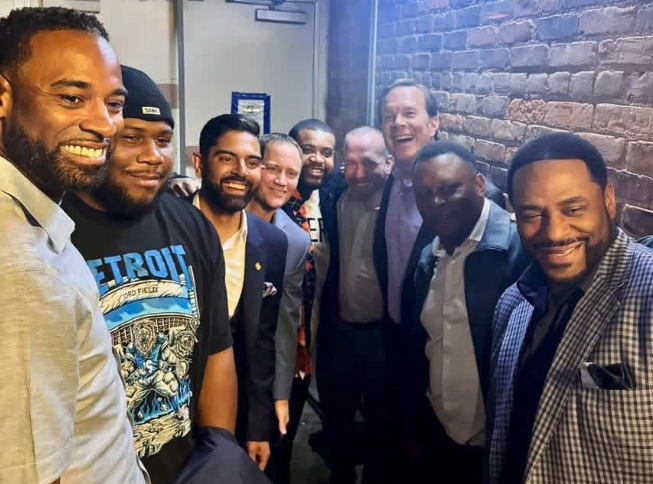
Former House Speaker Tom Leonard is facing intensifying scrutiny after posting photos of himself alongside top Michigan Democrats—images that critics say highlight his role at the time as a paid lobbyist working to influence those same lawmakers.

The photos, shared on Facebook for Detroit’s “313 Day,” show Leonard smiling with House Democratic Minority Leader Ranjeev Puri, State Rep. Donavan McKinney, and State Rep. Matt Koleszar. According to critics, the setting was not simply a casual or social encounter, but part of a Boys & Girls Club of Southeastern Michigan event where Leonard—who was lobbying on behalf of the organization at the time—helped bring in prominent Democratic officials.

The purpose, they argue, was clear: to lobby Democrats for money.

That context quickly transformed what Leonard described as a charitable, nonpartisan moment into a political flashpoint.

Hall Seizes on Lobbyist Optics

House Speaker Matt Hall wasted no time amplifying the issue.

“Looks like you were very cozy with Democrats when they controlled the House,” Hall wrote in the comment section of Leonard’s post, later adding that Leonard was “palling around with Democrats.”

But Hall’s critique went further than the photos themselves. By tying Leonard’s presence at the event to his role as a lobbyist, Hall framed the interaction as part of a broader pattern—suggesting Leonard was actively working with Democratic leadership to secure budget earmarks.

From Photos to Political Identity

Hall used the moment to deliver a sweeping indictment of Leonard’s record and alignment within the Republican Party.

By emphasizing Leonard’s engagement with Democratic leaders like Puri, McKinney, and Koleszar in a lobbying capacity, Hall argued that Leonard represents the very Lansing insider culture many Republican voters distrust.

He also invoked past criticism from former President Donald Trump, who labeled Leonard “an absolute embarrassment to the GOP” during his Attorney General campaign.

“He’s one of these Never-Trumpers who supported John Kasich and pals around with Democrats,” Hall said. “He drops the ball every time he needs to deliver a victory for Republicans.”

Undermining LG Viability

The implications of Hall’s argument goes beyond the immediate exchange.

By portraying Leonard as a lobbyist working closely with Democratic lawmakers to influence the state budget, Hall is attempting to disqualify him from consideration as a potential lieutenant governor pick.

In Republican primaries, alignment with the base—and distance from perceived insider deal-making—can be decisive. Hall’s framing suggests that Leonard fails both tests.

Hall also speculated that Leonard could be “auditioning” to join Detroit Mayor Mike Duggan’s independent gubernatorial ticket, further positioning him outside the Republican coalition.

Reinforcement From Republican Allies

State Rep. Matt Maddock echoed Hall’s criticism, reinforcing the narrative that Leonard is out of step with Republican voters and aligned with Democratic interests.

“President Trump still thinks Leonard is a RINO,” said Maddock.

This alignment among GOP figures signals that the critique may resonate beyond a single social media exchange and could shape broader perceptions within the party.

Leonard Defends the Event

Leonard pushed back, maintaining that the photos were taken at a charitable fundraiser aimed at supporting children in Detroit.

He highlighted his record of working across the aisle as Speaker, including efforts to expand the Freedom of Information Act to the Legislature.

However, Leonard did not directly address the criticism centered on his role as a lobbyist at the time or the broader implications of hosting Democratic lawmakers in that capacity.

Conclusion

As first reported by MIRS News, what began as a Facebook post has evolved into a broader debate about lobbying, political relationships, and party loyalty.

By tying Tom Leonard’s photos to his work as a lobbyist engaging Democratic leaders on budget matters, Matt Hall has delivered a pointed and potentially lasting blow—not just to Leonard’s gubernatorial ambitions, but to any future role he might play on a Republican ticket.

In a primary environment where outsider credentials and ideological clarity are paramount, the line between lobbying and liability has rarely been sharper.

Daines slips out of his primary; Trump needs a steady off-ramp for Iran

The Briefing Vol. XIV, Issue 11

March 16, 2026

This week:

  • Trump is still risking it all on victory in Iran
  • Daines slips out of his re-election bid in Montana
  • Dems may yet lose Va. gerrymandering referendum

Outlook

“No matter whom we elect, we always get John McCain.” 

We were not able to track down who said it originally, but this is a valid libertarian critique of Republican politics. No matter what the Republican candidate says about foreign policy, he eventually wins an election and starts dropping bombs on someone.

There was some irony when George W. Bush, who had campaigned in 2000 on a “humble foreign policy,” was the one to invade Iraq, starting a decade-long occupation that pretty much everyone now agrees was a mistake. 

There is probably even more irony that President Trump, the first Republican nominee in the modern era to campaign explicitly against foreign adventurism and the starting of new wars abroad, should be the one aspiring to effect regime change Venezuela, Cuba, and Iran within the space of three or four calendar months — and possibly also to cause the implosion of the much more powerful regimes in Russia and China. But he may yet accomplish several of these goals before his second presidential term is up.

So far, signs of a genuine rift within Trump’s coalition are still scarce. Most of MAGA-world supports the conflict, and anti-MAGA Republicans have been supporting it since long before Trump. Vocal opposition at this stage is largely limited to fringe figures. But cracks will start to appear if an appropriate off-ramp cannot be found from the hostilities — it is only a matter of time. 

Cuba: The domino in Venezuela already fell in January. And having been deprived of its Venezuelan oil, Cuba’s communist regime is now begging for talks with the U.S., despite having no leverage to bring to the table. The regime’s insistence that political reforms are not on the cards rings hollow, as Cuban demonstrators become increasingly violent and open about their opposition to communist tyranny.

When your communist dictator tries to quell the mob by admitting their “complaints and claims are legitimate,” you know things have really gotten out of his control.

Iran: Of course, the much larger endeavor here is Iran, whose regime will not fall over through anything short of a sustained campaign of external violence. This is still obviously the conflict that poses the greatest political threat to Trump and to his party in this year’s midterm elections.

Although much has been made of the inconsistency of his Iran policy, Trump chose to begin bombing on essentially this argument: If nothing is done about this regime now, it will quickly become too militarily powerful to stop, thanks to a buildup of either conventional weapons (missiles and rockets, as Secretary of State Marco Rubio put it) or a nuclear weapon, or both. Once Iran reaches a certain point, the reasoning goes, it will be able to keep destabilizing the entire region forever with impunity, using the dozen or so terrorist paramilitary proxy groups that it either created or started to fund (Hezbollah, Hamas, Ansar Allah in Yemen, various militias in Iraq, et cetera).

But most Americans want to see this war brought to a successful completion before it becomes another fiasco. They may display a great measure of patience in the short run, as long as U.S. casualties are minimal and there is no long-term commitment to occupy. But the pressure is on Trump now to find a nearby off-ramp where the conflict can stop but the regime has also been defanged as a practical matter. The longer this drags out, the greater the political danger he faces.

The possibility that Iran is so close to a nuclear breakout already suggests that last summer’s bombings of nuclear facilities were less successful than Trump advertised at the time (key facts here remain ambiguous). But the sharp drop-off of missile and drone attacks since the current conflict began is a sign that at least some of the concerns about Iran have already been dealt with. Its missiles, launchers and drones have been largely depleted in early attacks, and the factories that replenish them have been largely or completely destroyed as of this writing. The local population does not support the regime and is not mobilizing to defend it. Meanwhile, the regime’s internal security apparatus is, in some places, being targeted with precision strikes — and this offers the greatest hope of an internal regime-change, but the Iranian public has been largely deterred so far by ubiquitous threats that all protesters will be shot on sight.

The problem Trump faces, as we noted previously, is that the goals of the two sides are asymmetric in the extreme. Iran’s regime only needs to survive. It cannot compete militarily with the U.S., but it doesn’t have to win a single battle or even shoot down a single plane in order to achieve a strategic victory.

Senate 2026

Illinois: If you believe the polling, then Rep. Raja Krishnamoorthi (D) is favored to win the Democratic nomination tomorrow to replace longtime Sen. Dick Durbin (D). Also in the race are Lt. Gov. Juliana Stratton (D) and Rep. Robin Kelly (D), who was criticized for making fun of the two men awarded the Congressional Medal of Honor at Trump’s State of the Union address.

Louisiana: It’s not a good sign for incumbent Sen. Bill Cassidy (R) that his own internal poll shows him beating Rep. Julie Letlow (R) in a runoff by only a 45 percent to 43 percent vote. With Trump backing Letlow, this may be Cassidy’s last stand. Cassidy incurred Trump’s wrath by voting for the second impeachment against him.

Montana: At the last minute before the filing deadline earlier this month, Sen. Steve Daines (R-Mont.) bowed out and made room for his hand-picked successor, Kurt Alme (R), the former U.S. attorney for Montana. This sneaky tactic sidesteps any sort of expensive primary contest and heads off any aspiring Democrats who might have wanted a shot at the open seat. 

It will also probably work, despite being quite underhanded.

Democrats have a primary with five declared candidates, the most prominent of whom is one of the state’s 100 state representatives. But it is a sign of the times that Montana Democrats now view their own brand as unelectably toxic. They appear set to follow the Nebraska playbook — that is to say, to ignore their own nominee and fall in behind a Democrat pretending to be an independent in the form of former University of Montana president and military veteran Seth Bodnar (I).

House 2026

Virginia: With the state supreme court punting on making its decision until after the vote, Democrats’ attempt to gerrymander their state with a 10-1 Democratic congressional map (in place of the current 6-5 split) is hanging in the balance. 

Due to the highly unusual nature of the referendum they have put on Virginians’ ballots, it is hard to predict an outcome based only on turnout. But it is significant that early turnout is disproportionately high in areas that will be disenfranchised by the Democrats’ proposed map.

Which is to say, there is still a chance of beating this at the ballot box before a court gets involved to decide its constitutionality.

Republicans are cleverly using newly elected Gov. Abigail Spanberger’s (D) image and quotation in mailers promoting a “no” vote, even though she has come out in favor of the gerrymander.

Early voting is already underway, and the official election day is April 21.

Perry Johnson Gains Momentum in Michigan Governor’s Race as John James Support Shows Signs of Collapse

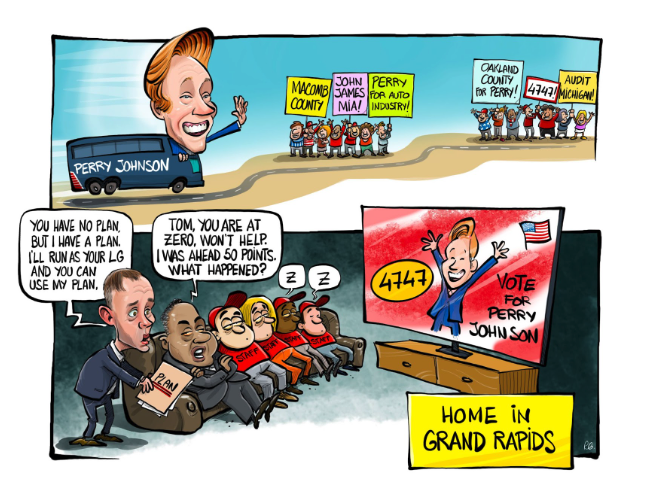
The Republican primary race for Governor of Michigan is entering a new phase as businessman Perry Johnson builds visible grassroots momentum across the state. Recent political events — including the Macomb County Republican Convention and the Saginaw County GOP debate and straw poll — have elevated Johnson’s standing among party activists and raised new questions about the durability of early frontrunner John James.

Activists, media commentators, and political observers increasingly say Johnson is emerging as a candidate to watch, particularly as James continues to skip key Republican forums and debates.

Johnson Dominates Macomb County Convention

One of the clearest signals of Johnson’s growing strength came at the Macomb County Republican Convention, where attendees repeatedly described him as the most talked-about candidate at the event.

Macomb County remains one of the most influential political regions in Michigan. Its blue-collar voter base and strong Republican grassroots network have historically played a decisive role in shaping statewide GOP primaries.

Political strategist Jamie Roe, a longtime Michigan Republican communications expert, noted the importance of Johnson’s strong showing there.

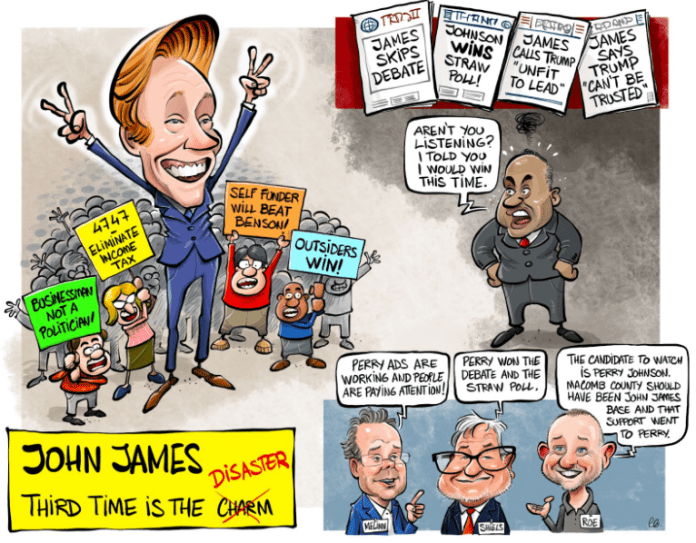
Perry Johnson has strong support in Macomb County and he’s the candidate to watch in this race,” Roe said in commentary on WDIV TV in Detroit following the convention.

Delegates reported that Johnson speech drew some of the loudest applause of the day and received enthusiastic reactions from activists eager to hear his message about tax relief and government reform.

Johnson’s campaign centers on his proposal to eliminate Michigan’s income tax while auditing state government for waste, fraud, and inefficiency — a message that resonated strongly with activists concerned about rising costs and government spending.

Multiple attendees said Johnson’s emphasis on applying private-sector management principles to state government distinguished him from other candidates at the event.

Saginaw Debate Victory

Johnson’s momentum continued just days later at the Saginaw County GOP debate, held at Saginaw Valley State University, where Republican candidates gathered to discuss policy and answer questions from party activists.

However, the most striking aspect of the debate was the absence of Congressman John James, who once again declined to appear.

James’ repeated failure to attend candidate debates has begun to draw increasing criticism from Republican activists who believe primary voters deserve the opportunity to hear directly from candidates competing for the party’s nomination.

Johnson, by contrast, used the debate to reinforce his central campaign message — that Michigan must dramatically reform state government and eliminate the income tax in order to compete economically with states like Texas, Florida, and Tennessee.

The audience response appeared to validate that message.

Following the debate, attendees participated in a straw poll of activists, which Johnson won decisively.

Longtime Michigan broadcaster Michael Patrick Shiels highlighted the result on his statewide radio program, noting that Johnson had come out on top.

Perry Johnson won the debate straw poll,” Shiels reported while discussing the event with listeners.

While straw polls are informal measures, they often serve as an early indicator of organizational strength and enthusiasm among party activists — a critical component in primary elections.

Media Observers Note Johnson’s Growing Visibility

Johnson’s campaign is also drawing attention from Michigan political media.

On The Big Show, a prominent political radio program, Kyle Melinn, editor and publisher of the widely read Lansing political newsletter MIRS, said Johnson’s television advertising campaign is making an impact.

The Perry Johnson ads are effective and people are paying attention,” Melinn said during the broadcast.

Johnson’s campaign recently announced a major advertising effort across television, radio, and digital platforms as part of what it describes as one of the most aggressive early campaign strategies in Michigan gubernatorial politics.

The advertising campaign highlights Johnson’s background as a businessman and quality management expert who has worked with thousands of companies to improve efficiency and reduce waste.

His message focuses heavily on government reform and tax relief — themes that Republican strategists say resonate strongly with voters frustrated by rising costs and economic uncertainty.

Political observers say the increased visibility from advertising, combined with Johnson’s appearances at grassroots events and debates, is helping him expand beyond his initial base of support.

The Debate Issue Looms Over the Race

While Johnson continues appearing at events across Michigan, critics say Congressman John James’ absence from key Republican debates could become a significant liability.

Primary voters often view debates as an important opportunity to evaluate candidates’ leadership, policy knowledge, and ability to defend conservative ideas.

For many activists, the willingness to appear at grassroots forums and engage with voters directly is seen as a measure of respect for the party’s base.

Johnson’s campaign has emphasized his willingness to debate anywhere in the state, committing to multiple candidate forums and calling on other candidates to participate.

Several activists interviewed after the Saginaw debate said James’ absence was noticeable.

“When one candidate shows up and another doesn’t, voters draw their own conclusions,” one attendee said.

A Shifting Race

Only months ago, the Michigan Republican primary appeared to be dominated by John James, whose statewide name recognition from previous Senate campaign losses gave him a substantial early advantage.

However, political races often change quickly once candidates begin campaigning actively across the state.

Johnson’s strong performances at grassroots events, combined with his growing media visibility and advertising campaign, appear to be reshaping the dynamics of the race.

His central policy proposal — eliminating Michigan’s income tax — has become one of the most widely discussed ideas in the primary.

Supporters argue the plan would make Michigan dramatically more competitive with lower-tax states that have seen rapid population and business growth in recent years.

The Road Ahead

The Republican primary for governor remains competitive, with several candidates still vying for the nomination. But the past several weeks have highlighted a clear shift in energy among Republican activists.

Between the enthusiastic reception at the Macomb County convention, the victory in the Saginaw debate straw poll, and growing recognition from political commentators, Perry Johnson’s campaign appears to be gaining momentum at a critical moment in the race.

As strategist Jamie Roe put it, Johnson may now be the candidate many Republicans are beginning to watch most closely.

With more debates, campaign events, and advertising still to come, the question facing Michigan Republicans may no longer be whether Perry Johnson can compete in this race — but whether his growing grassroots momentum can carry him all the way to the party’s nomination.

Noem out: First blood for Trump 2.0

The Briefing, Vol. 14, Issue 10

Mar. 9, 2026

This week:

  • Trump’s invincible administration sheds its first blood as Noem falls
  • Iran conflict still not dividing MAGA, but it could start soon
  • Republicans now face a serious challenge in Texas 

Outlook

Noem sacking: The firing of Homeland Security Secretary Kristi Noem is a critical milestone if only because this is the first sacking of a Cabinet secretary in Trump 2.0. The current administration has been shocking for its stability, especially after Trump’s chaotic first term.

Why did it happen? One reason Trump’s Cabinet has been so stable is the premium he puts on loyalty. Even if you mess up, he won’t feed you to the wolves just to quiet them down. The only sin that can do you in under Trump is to be disloyal. This appears to be what Noem did when she intimated that Trump knew about the $220 million ad campaign she commissioned, prominently featuring herself riding on horseback — a presidential campaign ad if we’ve ever seen one. 

It didn’t help that she couldn’t just say “No” when asked under oath in a committee hearing about an alleged affair with longtime Trump-world staffer Corey Lewandowski. Even if Trump could tolerate her earlier shooting from the hip about “domestic terrorism” by the two U.S. citizens shot while obstructing immigration enforcement, he was not going to be wrongly blamed for her self-promotion.

Yet there is also some irony here. Although one might hesitate to credit Noem for it, her department has been one of the most successful in Trump’s second administration just for its operational control of the U.S.-Mexico border, to say nothing of its repurposing of existing resources for Trump’s promised program of mass deportations. As of October, the administration said more than 2 million illegal residents had left the U.S. — more than half a million forcibly deported and another 1.6 million self-deporting.

In a way, this actually makes Noem’s firing easier to understand. Why risk such a top priority for the administration — and something that is going well as it is — by keeping someone so controversial around, especially at a moment when much of her department is in a government shutdown?

Trump’s choice of Sen. Markwayne Mullin (R-Okla.) guarantees a relatively uncomplicated confirmation process in the U.S. Senate. It won’t result in a significant policy change or loss of faith in the administration’s priorities, and it might even help get the Department of Homeland Security funded again.

It also won’t cause too much trouble for Senate Republicans keeping their majority, since Oklahoma is no longer competitive statewide.

Iran War: War is obviously a terrible, dangerous and deadly thing — every instance of collateral damage, no matter how unintentional, is a heavy reminder of this, and we don’t mean to minimize it. 

That said, our aim is to analyze the conflict in Iran from a political perspective. And in that light, we have a mixed bag so far.

Among the positive developments: Iran is already defeated in terms of conventional military power, which is better than most people expected. Also, just as Russia’s much-vaunted military has been exposed as a sham in Ukraine, China’s military technology, including stealth radar and anti-aircraft systems, has been exposed as garbage, having failed to detect or shoot down even a single U.S. or Israeli warplane. This is more than just a consolation about China making any attempt to seize Taiwan — it is also a glaring warning for all the small countries out there considering entering China’s orbit in exchange for infrastructure funding. The idea that China is a good friend to have or a useful partner is being blown away in real time. If you want weapons that work and win wars, you probably want to deal with the U.S. instead.

Also, between Venezuela and Iran, a significant amount of China’s oil supply has been cut off, driving the local price above $100 per barrel, up from a huge sanctions discount below the world price. In terms of grand strategy, Trump is winning here, successfully limiting China in its ability to cause trouble, at least for now. 

This is all coming just before Trump’s anticipated meeting with Xi Jinping, and knowing Trump, he probably wouldn’t have it any other way. It puts him in a position to make bigger demands and give fewer concessions.

On the downside, there is already great pessimism about this conflict coming to a swift conclusion. And despite early U.S. and Israeli successes in decaptitating the Islamic Republic’s leadership, the regime does not have to shoot down a single U.S. plane or win a single battle in order to win the war. As long as the war remains an air war, what’s left of the regime needs only to cling to power by its fingernails, avoiding both an internal coup d’etat by its regular army and a popular uprising sufficiently strong to remove it.

The risks of this conflict grow for Trump the longer it goes on. To whatever extent the Iranian regime can hang on and block the Strait of Hormuz, it can cause serious price inflation in the U.S. political pain for the administration.

Meanwhile, although most of the MAGA movement seems to be okay with Trump behaving hawkishly for a time, there will be limits. The movement is fraying just a little bit at the edges, with high-profile influencers and lawmakers becoming more critical of Trump. This isn’t a serious problem for him yet, but put a pin in it — it could become one if Trump gets the U.S. mired in this conflict.

On the other hand, if the war ever becomes a ground war, that makes for an entirely different (and much worse) calculation for Trump. 

Senate 2026

Texas: State Rep. James Talarico (D), with an assist from Stephen Colbert, defeated Rep. Jasmine Crockett (D) to win the Democratic primary. This is widely viewed as the best outcome for Democrats, simply because Crockett is such an erratic character. However, Talarico has his own weaknesses as well.

Unfortunately for Republicans, their primary is as unresolved as it can be. Incumbent Sen. John Cornyn (R) unexpectedly placed first in the primary, finishing just ahead of Attorney General Ken Paxton (R) 42 to 41 percent. This came as quite a surprise, since Paxton had told the Ruthless podcast that he thought he might just win the primary outright in the first round. 

Although this initial result may offer hope to some who are backing Cornyn, not a single poll has suggested at any time during this race that he can reach 50 percent in the May runoff. 

Cornyn achieved his first-place finish by crushing Rep. Wesley Hunt (R) in round one. But the conventional wisdom holds that the second round of balloting may feature a much more conservative electorate that is more willing to take a chance on Paxton. 

Cornyn is widely believed to be the stronger general election candidate — mostly because of Paxton’s multiple ethics problems but also because of Paxton’s underperformance in last week’s result. But both Paxton and Cornyn have strong track records of winning statewide elections in Texas, in Paxton’s case, despite the ethics problems being well known. Also, Paxton got his 41 percent tally on the cheap, whereas Cornyn had to spend more than $70 million to beat him by one point.

President Trump has stated that he will endorse one of the two candidates, and that the other should drop out. To heighten the drama further, Paxton offered to drop out if the SAVE America Act becomes law — a voter integrity measure that Trump has promised to sign. But its passage would require a talking filibuster, which seems exceedingly unlikely at this point and would require the Senate leadership (of which Cornyn is a key member) to tie up the floor long enough for Democrats to give 94 speeches of unlimited duration — something they seem loath to do.

It is an ominous sign for Republicans that, despite their contested primary, Democrats beat them in turnout by nearly 150,000 votes. This is the first time Democrats have done this since 2008. Although that doesn’t necessarily mean anything (Democrats haven’t had a truly contested primary in quite a while), primary turnout can sometimes be a sign of a party’s rank and file being enthusiastic to vote.

Democrats have not won a statewide race in Texas since 1994. Republicans would really rather not have to spend another $100 million on this race, but it looks likely to happen.

A Democrat-commissioned poll shows both Paxton and Cornyn trailing Talarico within the margin of error. But it should be noted that even independent polling in Texas generally underestimates Republican performance.

First primary looms tomorrow; Trump rides high on State of the Union, Iran decapitation

The Briefing, Vol. XIV, Issue 9

March 2, 2026

This week:

  • Trump delivers powerful State of the Union speech
  • Trump gambles it all on an Iran regime-change operation
  • Graham Platner: Raging bull or paper tiger?

Outlook

State of the Union: Despite its great length, (length can be a true speech-killer) President Trump delivered by far the most powerful State of the Union speech of his presidency so far. And it hit all of the hot notes we anticipated, and then some.

Trump not only raised the key issues to highlight his most popular accomplishments — on crime, immigration, inflation, and the restoration of sanity post-Woke Era — but he put on a tremendous show. 

Again and again, he induced Democrats to take the wrong side of an 80-20 issue. They refused to stand up and cheer for weeping mothers of crime victims; for the families of people whose lives had been devastated by reckless-driving illegal aliens; for a young woman who at age 14 had been essentially kidnapped by public school authorities, taken across state lines and gender-transitioned against her parents’ will, resulting in her running away from home and being sexually abused in multiple states. Why, many Democratic lawmakers even refused to cheer for the gold-medal U.S. Men’s Hockey Team. In their liberal bubble-world — reinforced by a lot of frivolous journalism that in no way reflects actual public opinion — the team had supposedly transgressed by inviting FBI Director Kash Patel into their locker room celebration and laughing at a joke Trump made over the phone when he called to congratulate them.

The speech had its intended effect of improving Trump’s image, reinforcing Democrats’ extremism, and resetting the issues ahead of the midterm elections. According to the ratings, 33 million people watched, and Snap polls suggested that of those who watched, and two-thirds of them came away with a positive reaction to the speech — 64 percent said they believe Trump’s policies will move the nation in the right direction.

Iran: The luring of Democrats into traps continued apace as the week wore on. The State of the Union feels like it was a year ago at this point because of the next bold U.S. foreign policy move. 

In the last two months, Trump has arrested and renditioned Venezuelan dictator Nicolas Maduro, killed Mexican Cartel boss Nemesio “El Mencho” Oseguera, and put Cuba’s 67-year-old communist regime on the ropes. Then, over the weekend, he launched a much-anticipated operation to weaken Iran’s theocratic regime and encourage a popular overthrow of its government from within. This included decapitation strikes, in conjunction with Israeli forces, that swiftly killed off much of Iran’s leadership, including Supreme Leader Ali Khamanei and leading military leaders in the Islamic Revolutionary Guard Corps.

There is a real sense that Trump intends to settle all family business this term, if not this year.

Democrats have been divided over the operation. Some are even walking into the trap of rooting for or almost rooting for the mullahs.

For Trump, the attack is a highly controversial move, given his positioning since the beginning of his political career as an anti-war political leader. Some Republicans are very uncomfortable with it — indeed, he seems to be carrying out something that looks very much like the foreign policy of the Never-Trump wing of the party. 

At this point, many of Trump’s biggest fans are trying to justify the operation in their own minds as a relatively low-commitment affair with little risk of spilling over into a greater long-term conflict. Strangely, they are probably right. As far as negative consequences or blowback, that seems unlikely — the Iranian public seems genuinely enthusiastic and the Gulf Arab countries are low-key supportive after Iran reacted immediately by targeting random civilian buildings in their countries. 

Meanwhile, the Iranian regime itself and its terrorist proxy militias (Hezbollah, Hamas, Ansar Allah), already much-weakened by earlier operations (such as the exploding pager plot), had already been doing almost as much as they could to attack and disrupt U.S. and allied interests abroad, including assassination plots and attempts against Trump himself and multiple other Americans and westerners in allied countries

In short, there wasn’t much to lose in terms of the existing regime’s good will.

One poll shows overwhelming disapproval of the strikes (43 percent against to 27 percent in favor), but the number there doesn’t quite square with other surveys showing as many as 51 percent supporting such an attack just before it started. But the key for Trump, in political terms, is to avoid letting the operation drag out or result in mission-creep. As the material losses and human casualties involved are de minimis, the public will accept an operatio with a positive outcome. 

Endgame: Trump’s operation is risky and may well fail. But one criticism is completely unfounded: Those who argue that Trump has no endgame are simply uninformed. 

The endgame has always been there in plain sight. In an optimistic scenario, the end comes when Iran’s regular army intervenes and restores order, displacing the fanatics of the Islamic Revolutionary Guard Corps and the mullahs who have run the Islamic Republic since the 1979 revolution. Presumably, the U.S.-Israeli operation would never have been launched if that had not been viewed as a realistic possibility.

Even failing such an optimistic result, there is an alternative endgame. An intermediate victory would come in the form of a much-chastened third-string Iranian leadership accepting a nuclear deal on Trump’s terms in order to avoid total annihilation. 

Either way, the attack against Iran has already dramatically weakened China, which depends on Iran for oil, and Russia, which has depended on Iran for a steady supply of low-cost drones in its conflict with Ukraine.

Obviously, war has dramatic and disastrous consequences whenever it occurs. But from a purely political perspective, the disaster scenario for Trump and Republicans is a conflict that spreads or results in serious U.S. losses.

Senate 2026

Maine: Democrats are getting increasingly nervous as communist oyster farmer Graham Platner (D) glides toward a primary victory over the establishment favorite and polls start to come out suggesting that he will lose badly to Sen. Susan Collins (R). 

The campaign of Gov. Janet Mills (D) may be desperate at this point, and the polls are both partisan (one Republican, one Democrat), but results that show Platner defying gravity fly in the face of Collins’s track record in statewide races. Mills’s own internal poll, by Impact Research, shows Platner losing to Collins by double digits, 55 to 41 percent. A Republican poll by Tony Fabrizio has Collins leading Mills by just one point but leading Platner by a similar 13-point margin, 51 to 38 percent. 

The Mills campaign highlighted this in a late February memo, arguing that other polls are oversampling younger voters.

Meanwhile, unions in Maine are trying to make Democratic leaders back down from intervening on Mills’s behalf in the primary — highly unlikely, since they recruited her. Surveys of the Democratic primary vary between a very large Platner lead over Mills and a five-point lead for Mills over Platner.

The same week, Platner sat down for a podcast interview with a host known for conspiracy-mongering and antisemitism.

Platner was also endorsed by Sen. Ruben Gallego (D-Ariz.).

Massachusetts: Sen. Ed Markey (D) looks surprisingly weak against primary challenger Rep. Seth Moulton (D). The incumbent leads only 35 to 23 percent, according to a survey released last week by the University of New Hampshire. The only saving grace for Markey is that the numbers haven’t moved against him since the same poll was taken in January.

Texas: With Election Day looming tomorrow, the Democratic primary between establishment favorite state Rep. James Talarico (D) and Rep. Jasmine Crockett (D) is far too close to call. A new Emerson poll shows a statistical tie between the two (52 to 47 percent, Talarico) with Talarico leading among early voters and Crockett set to dominate tomorrow’s vote on the day-of. Her ability to win the primary depends mostly on getting out the black vote; it could even depend on Republicans crossing over in the open primary and voting for her instead of bothering with the messy Republican primary.

On the Republican side, there is virtually no doubt that Attorney General Ken Paxton (R) will finish first, but he will probably still be shy of an outright majority. He is at 40 percent in the Emerson survey and could come closer to an outright win than anyone expects. Paxton will also be the clear favorite in any May runoff. 

Sen. John Cornyn (R), despite already spending an astounding amount of money on the primary — it could approach $100 million when it’s all said and done — has failed to improve his standing all the same. Still, the Emerson survey puts him at 36 percent, in second place like many others. He will almost certainly finish second, ahead of Rep. Wesley Hunt (R), and make the runoff.

Hunt never caught fire as the alternative candidate, more pleasing to the base than Cornyn but less scandal-plagued than Paxton. Trump, who has good relations with all three, could still intervene if he wanted by appointing Cornyn to the federal bench. Were Cornyn to withdraw from a runoff he is nearly certain to lose, the candidate with the third-greatest vote total would take his place on the runoff ballot, according to state law.

House 2026

Texas: Two House races worth watching on Tuesday. First, in Texas-2, Rep. Dan Crenshaw (R) is in a serious fight after Sen. Ted Cruz (R) made a late endorsement of his primary opponent, state Rep. Steve Toth (R). 

Second, we are told to watch Texas-31, where octogenarian Rep. John Carter (R) is mired in a ten-way primary (one of the candidates is “Shamwow guy” Offer Vince Shlomi) and might be forced into a runoff.