
The Briefing, Vol. XIII, Issue 51
Dec. 22, 2025
Note to readers: The Briefing will take next week off in observance of the upcoming holiday. Merry Christmas, and see you in the new year!
This week:
- What Trump 2.0 can say it accomplished in 2025
- Stefanik abruptly drops out
- Lummis to retire
Outlook
The second Trump administration’s first calendar year is at a close. If you want to see whether Trump 2.0 is making a tangible difference in the life of the nation, this is probably the first chart you should consult:
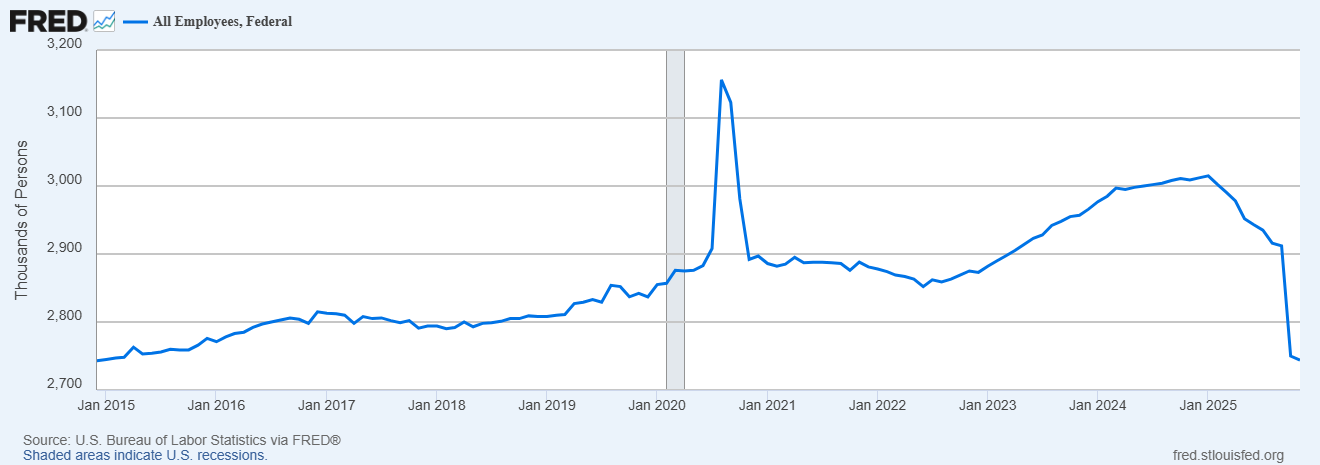
Government efficiency: In less than a year, President Trump and his Elon Musk-led and inspired DOGE government efficiency effort have reduced federal civilian employment to its lowest level in about 11 years. They did so using a massive buy-out incentive for many federal employees and imposing mass layoffs or virtual departmental closures for others. (Note that the spike in the middle of the graph is due to temporary hiring for the 2020 U.S. Census.)
Perhaps that is less impressive than it sounds. After all, as the chart indicates, this is not truly a long-term low in the number of employees. Trump has merely reduced the size of the government workforce from an elevated Biden-era level back to where it had been between the late Clinton and late Obama eras. Truth be told, there were roughly the same number of federal employees in 1966 as there are now.
And government employment should probably be much lower today than it was in the 1960s, despite the nation’s roughly 40 percent population increase since then. Consider: Government-wide, there were once tens of thousands of file-clerks, couriers, elevator operators and typists, to name just a few roles that have been almost fully de-specialized or automated in the last 50 years. Today, given automation, as few as five or six employees can run a busy fast food joint, compared to 15 or 20 in the 1990s. Other industries have streamlined their processes without sacrificing their mission or harming the economy overall. So it stands to reason that federal government employment today should be smaller than it was during the Vietnam War. But this should not be taken as a sign of failure. There is every reason to believe that Trump could go much further in year two to reduce government employment — perhaps by offering a second-chance buy-out for demoralized federal employees or expanding DOGE efforts, which (some may forget this) are still ongoing after Musk’s departure.
Also note that all Trump-era employment statistics are showing and will show this as an overall loss of jobs.Yet unemployment has not spiked, and the government has not ceased to function. This is all evidence that these reductions-in-force are salutary and probably help the economy elsewhere.
Immigration enforcement: Even aside from that, the chart above is nothing to sneeze at. It shows greater progress in a single year toward a smaller federal government than anyone has made in decades. If the entire ethos of Trump 2.0 is to pull up one’s sleeves and accomplish things conservatives had always just assumed were impossible, this is a great example of that being for real. And for all those who doubted Trump’s conservative bona fides, it is a very reassuring effect of his second administration — and just one among many.
Another data point about Trump 2.0: More than 2.5 million illegal aliens have supposedly left the U.S. since Trump took office. This includes more than 605,000 deportations and 1.9 million recorded self-deportations as of early December.
Although it varies based on jurisdiction, the administration has mostly focused on the “worst-of-the-worst” as promised, arresting illegal aliens who have criminal convictions, face criminal charges, already have removal orders, or are wanted in their home countries for crimes committed there. There is already evidence in the early data for arrests through October 2025 that jurisdictions more helpful to ICE (Idaho, for example) are arresting a substantially higher share of targeted criminals and aliens ordered removed, and a lower share of accidental bystander illegal immigrants, compared to less-helpful or sanctuary jurisdictions (like the District of Columbia). This is much like Tom Homan had promised.
These deportations, including those resulting from Department of Transportation enforcement on semitruck drivers, will have several beneficial effects. Insofar as they focus on criminals, they will serve as a force-multiplier for reducing crime.
This benefit may not be fully appreciated until next September, when the FBI releases its national crime numbers, but there are already signs of people feeling safer in their own neighborhoods. Trump can benefit politically if there is a sense that American cities don’t have to be the chaotic, intractable dystopias that liberals present — that, in fact, there are simple answers to many of their worst problems, so long as liberal shaming is ignored.
In D.C., for example, between Jan. 1 and Aug. 11, 2025, there were 99 homicides, which put America’s capital on pace for a yearly total of about 170. In the time since Trump ramped up both ICE and other federal law enforcement activity in the District in August (and deployed the National Guard in a mostly theatrical show of force), there have been only 27 homicides, for an annualized pace of less than 70 per year. That would be the lowest number since at least 1960, when there were only 81 murders.
D.C. is a special case, given the level of federal power and activity there. But expect to see even greater benefits in other places where more of ICE’s enforcement focus has been on removing accused or convicted criminals, ranging from murderers and child-rapists to drunk drivers.
Second, the Department of Transportation is cracking down on the trucking industry. The removal of truck-drivers from the roads who cannot read English-language road-signs or speak English to the highway patrol will almost certainly reduce serious road accidents involving trucks.
Application to ‘affordability’: Finally, DHS is ringing in the holiday by tripling the stipend it will offer illegal immigrants to if they sign up by year’s end to self-deport on the agency’s CBP app. This raises the possibility of further moves in this direction in the near future. Even a $3,000 stipend plus the cost of an airline ticket is significantly less than the estimated $13,000 to $20,000 that it costs to deport one person, between the actual transportation, detention and the legal process. This hints that 2026 could see even greater demand-side price-reductions and perhaps even more job openings. Note that job-openings have been at historically high levels (above 7 million) since late 2017.
You may wonder how this applies to the “It’s the economy, stupid” concept that James Carville pioneered in the 1990s, and it’s a fair question. There is at least a theoretical connection. According to economic theory, removals and departures will tend to improve affordability — the political buzzword of 2025. The idea is that the mass departure of undocumented immigrants will reduce demand and competition for scarce resources such as housing and food, bringing down prices. This effect will be less dramatic to the extent that it succeeds in causing wages to rise in industries where unauthorized immigrant labor comprises a disproportionate share of the workforce — truckers, construction workers, farm workers, etc. Even so, wage increases can be sold to some voters as an “affordability” benefit, albeit one concentrated in a smaller pool of workers.
In short, although we have spent the last few weeks looking at the massive political challenge Trump faces in the 2026 midterm, he has a story he can potentially sell to voters, assuming that a lot of things go right over the course of the next ten months.
Governor 2026
New York: Rep. Elise Stefanik (R) abruptly and surprisingly dropped her bid for governor over the weekend and retire from the House as well. She told supporters in an email, “I have thought deeply about this, and I know that as a mother, I will feel profound regret if I don’t further focus on my young son’s safety, growth, and happiness—particularly at his tender age.”
As with all politicians, one is tempted to write off the old “to spend time with my family” explanation as a cop-out. The reality is, Trump declined to endorse her when given the opportunity. Stefanik’s departure leaves Nassau County Executive Bruce Blakeman (R) as the only declared Republican in the race. The speed with which Trump endorsed Blakeman after Stefanik’s departure has encouraged speculation that there was a cause-and effect relationship between the two occurrences.
Senate 2026
Wyoming: Sen. Cynthia Lummis (R), who carved out an issue for herself in the area of cryptocurrencies, will not seek a second term, she has announced. Rep. Harriet Hageman (R), who defeated former Rep. Liz Cheney in the 2022 primary, is expected to announce for the seat. If not, Gov. Mark Gordon (R), who is term-limited and cannot run for re-election, would be another possibility.
There is surprisingly little buzz in any media about Cheney potentially running as a Democrat.


